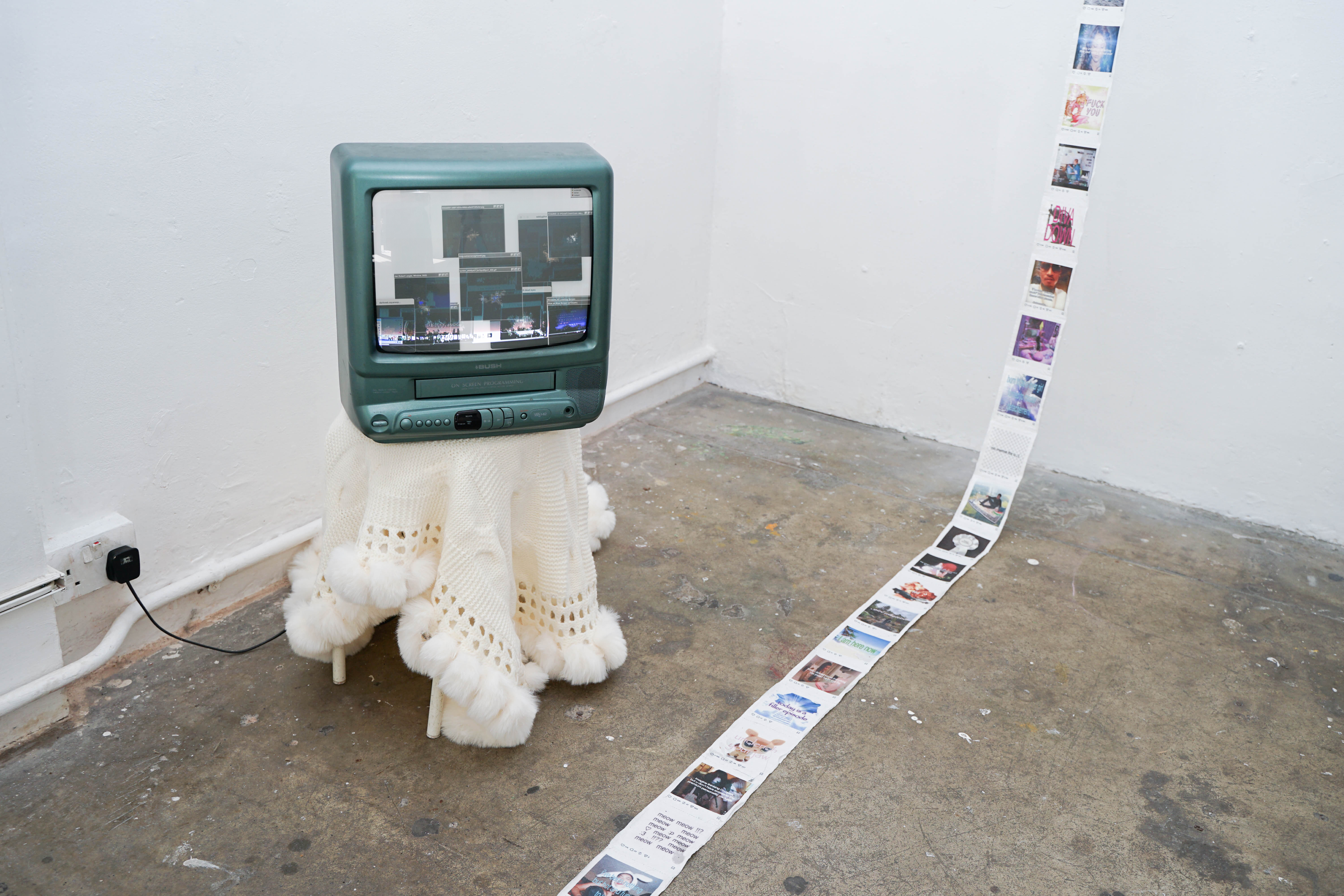




“I feel like the multi-faceted nature of my practice runs into my life. The odd jobs that I do from presenting, hosting events, to my work as an artist, it’s all me coming out in different ways,” Tegan tells me at Elephant and Castle studio before we’ve even sat down for our conversation.
Tegan Chinogurei is an artist, as she describes herself, ‘a maker’. Her work explores the intricacies of being Black in Britain and how this involves itself in the experience of being first born on British soil in her family. Her works across sculpture, and previous works in video, expose her nostalgia and a reckoning with the truth that surrounds memories that at the time feel more simplistic than reality. As she shows me around her shared studio space, she points out her ‘surgical table’ where a mound of materials are in the early stages of becoming her next piece for her first Frieze Week exhibition. She invites me to sit amongst the piles of wood, power tools, and emblems of Stevenage that adorn every corner.
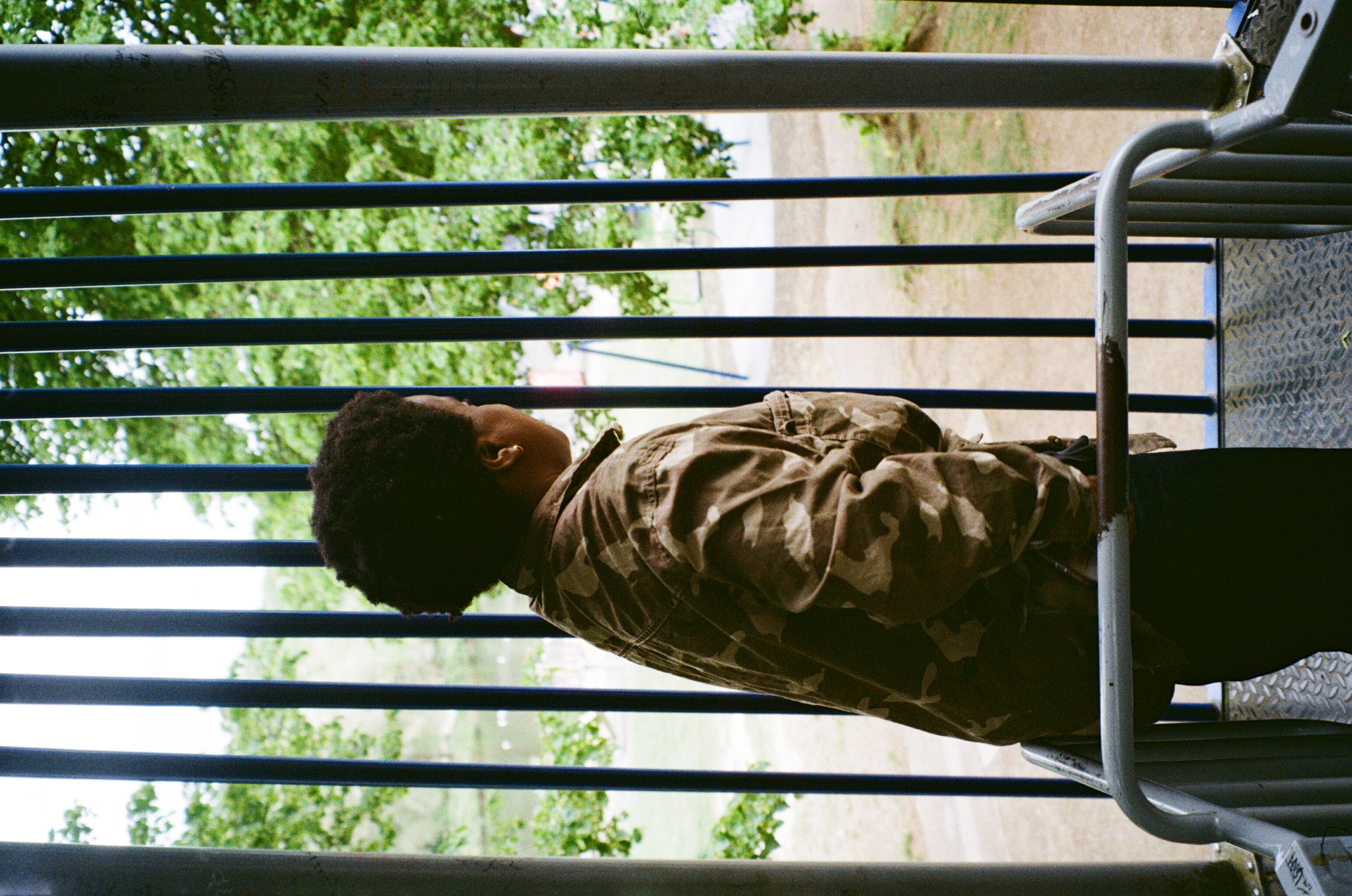
Since graduating from Central Saint Martins, Tegan has been keenly continuing her practice as an artist, finding herself as part of the Associate Studio Programme - a post-graduate scheme for a number of fine artists continuing their practice after graduation. I first ask Tegan what word best describes the place she feels she’s at in life right now. “Limbo? like everyone after graduating, well maybe not everyone. I don’t want to say that’s my word actually because I feel that limbo means I don't have a sense of where I’m going and I think I do.
"Right now I’m trying to facilitate everything I want to be creatively. I’m trying to understand how to mediate all my interests to the best of my ability, but I’m actively dreaming. It’s like wishing on a star to see what will happen”.
This attitude towards her practice is something Tegan has always carried with her in. Having grown up in the same hometown (Stevenage), despite being in different year groups, Tegan and I become friends naturally through often passing her dancing through the school hallways. That same spirit of dancing through spaces feels inline with the state of dreaming she takes on now in pursuing her life as an artist. With every work Tegan reflects an ability to take risks, but in doing so she always shows up fully herself.
I ask if art was always something she felt she would do. Tegan asserts a firm ‘no’, that she was very much academically driven throughout school. “I thought I would become a historian, which is funny. But even those childhood passions come into fruition in my practice.” In works like The Last Supper (2022), a stained glass window exploring ‘the last hurrah before adulthood’, this shines through. These are reflections of her young self coming into conversation with her current state, puzzle pieces in understanding her identity now.
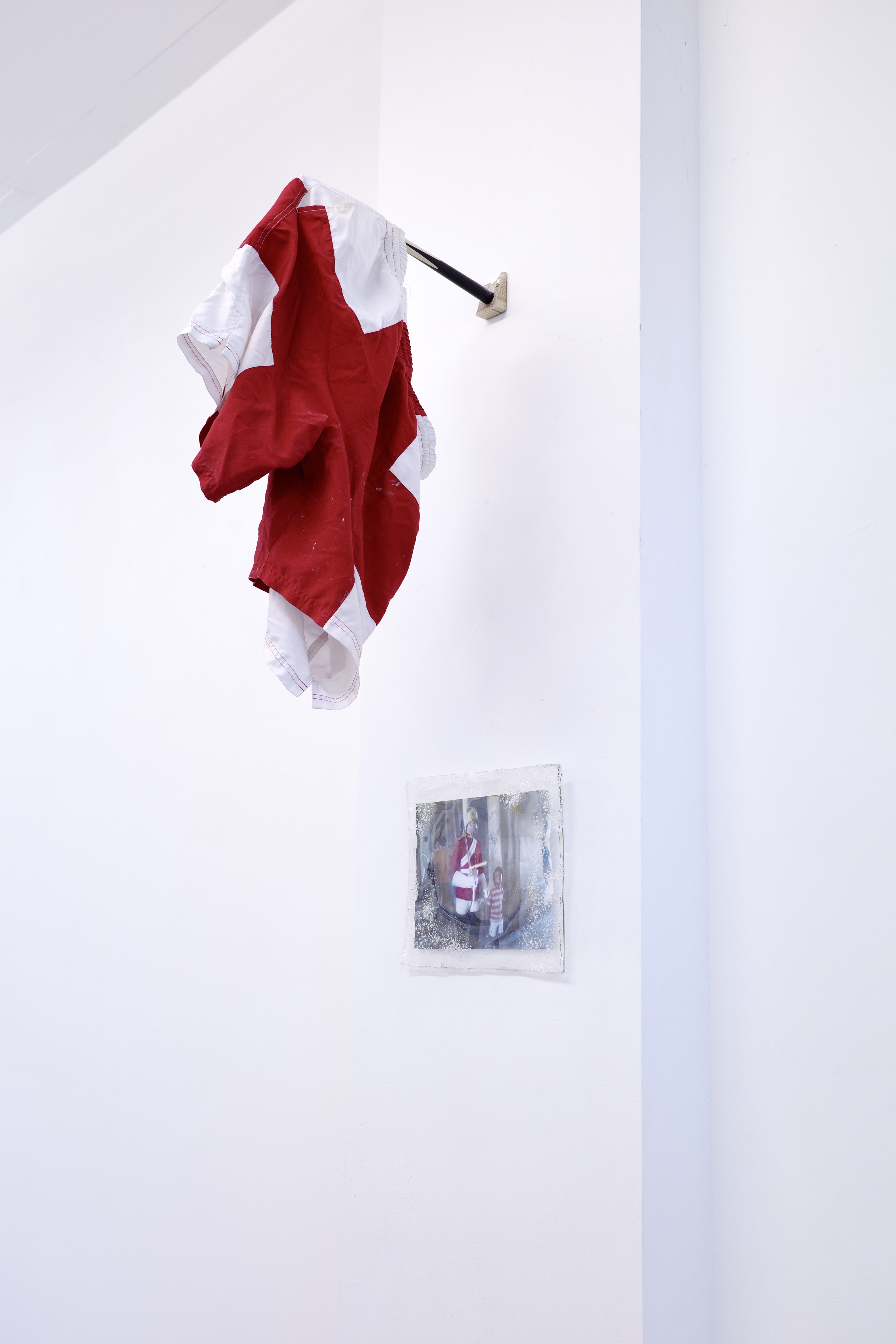
She describes her work as ‘fake relics’, currently focused on interrogating her relationship with her British identity in contrast to lack of access to her roots in Zimbabwe, “When you're in situations in which there's family trauma tied to home it does leave you at a loss. I feel that within myself. For a while I didn’t understand my own identity in its complexity. My mum’s from Zimbabwe, I’m British, there’s a lot of things you can unpack from that as someone living in the land that colonised the country my family once called home”, reflected in her recent work Diaspora Dreams, a piece including a photograph of Tegan as a child with one of the Queen’s Guard's, beneath a pair of St George’s shorts hung like a flag above the image. The work explores the illusion sold to many who immigrated to Britain. “To the greater world they won't maybe see me as British, but I don’t feel like I need to prove who I am to anyone. I’m trying to navigate that in my works, I’m showing glimpses into my world through it. It feels therapeutic, I'm discovering new things about myself when I make work, it becomes an extension of my identity”.
When you meet Tegan, Stevenage will likely quickly (and repeatedly) be part of the conversation. The sense of pride in her hometown articulates through her work, this deep connection manifests in her work in a way that allows you to interrogate your own relationship to the growing pains we face at home, feelings we might otherwise ignore. Tegan gives credit to how important these memories are in shaping the people we are wherever we find ourselves in the world, “when you’re placed somewhere, whether you love it or hate you feel territorial for that place. I remember when I got my first whiff of London life, I was like sod Stevenage. My eyes were so bright in all the photos I took when I first came to the city. But I slowly started to miss home. I don't know what it is, maybe the sense of community there, it’s such a family place. When it’s cold outside I would rather be cosy in Stevenage”.
When I ask Tegan if it’s possible to describe Stevenage in one word, she pauses. “Resilient? Maybe a bit of Stockholm syndrome,” she laughs. “Me and my friends had times where we’d have to be in food banks but now we’re here doing things we could never have dreamt of doing. We’ve been able to change the narrative around us. Another word would maybe be boisterous. When I think about my childhood on the estate, we used to jump into skips, take things out, I don't know how we didn't get tetanus…I remember there was this one guy on the estate who we saw juggle out his window once. For maybe a week we would knock on his window and ask him to juggle for us and he would! When people would leave the estate, the cleaners would come and we’d climb the windows into the empty houses. Those boisterous memories, we were just so curious as kids”.
In exploring that connection to Stevenage I ask if she feels the same when regarding England as a whole, if the same regard for her hometown is felt countrywide. "I feel territorial about Stevenage but not the whole of England. English culture is an amalgamation of so many things, and while rising fascism reveals so many people are anti-diversity, England is built off the back of diversity. Without those things what would English culture be? Though my work is on English culture it feels like a double edge sword. I think about Dubois’ theory of double consciousness, with being in the coloniser's land you see yourself as yourself in the eye of the coloniser alongside how you see yourself. I feel that in Stevenage too though and it’s weird.”
On this thread I bring up Tegan’s residency at Jaywick, “I did a residency there and I remember on St George’s Day they had a church attached to the Never Say Die pub. We were doing gospel choir at the church and as soon as it ended we had Karaoke in the pub. The choir MC went to the pub mic and said, ‘British songs only, British only’. Despite the start everyone was singing so beautifully, it felt like church in the pub. Similar to Stevenage it felt like the town was in its own bubble, but I realised karaoke is a good way to bring people together which inspired my piece God Save The Sesh. I don’t want to make things you can’t touch or experience, I want people to touch my work and be a part of it”.
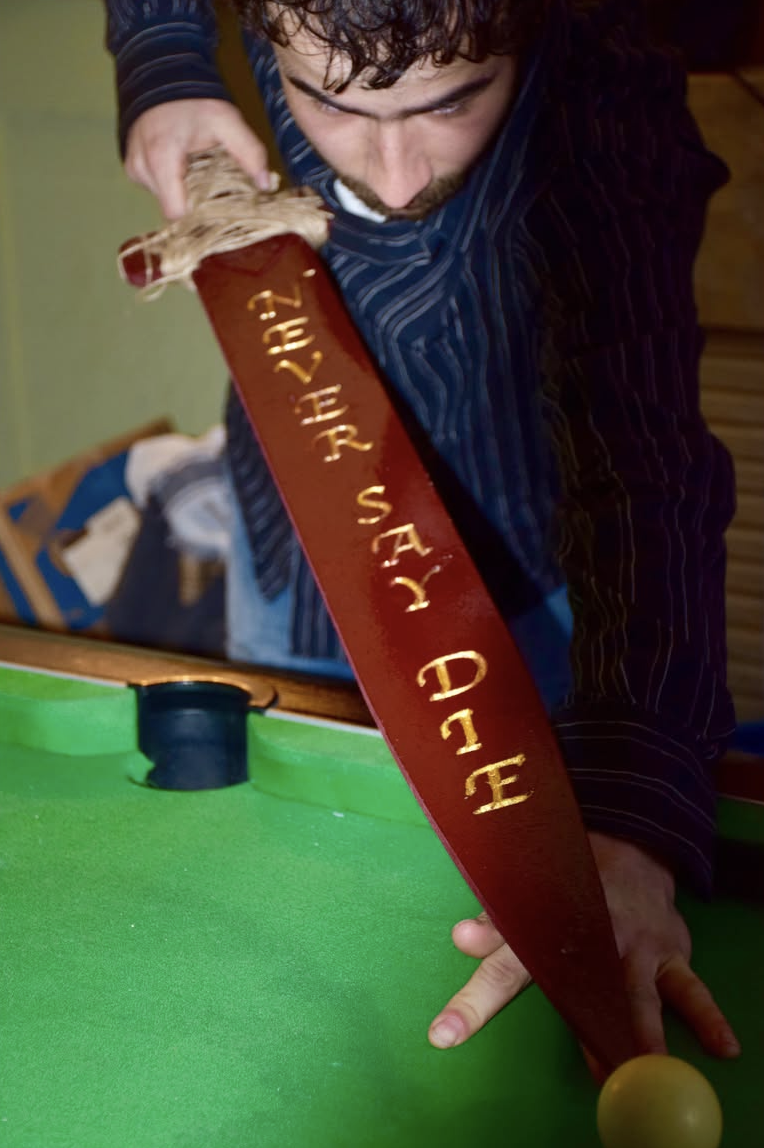
Tegan’s explorations of British identity is consistently bold in narrative, in pieces like STEVO TILL I DIE (2023), a crucifix formed from a pool table - a meditation on pub culture and religious influences from her primary school days makes an appearance again at her recent joint exhibition with Ace Rahman, Chronically Brit*sh. “It was in response to last summer’s riots along with seeing this rise in far right facism. We wanted to bring our perspective and lens for our individual diasporas and bridge a conversation between Black British and British-Bengali art. A lot of the struggles we meet as people of colour are the same and It was really nice to have that conversation through the exhibition. With the crucifix pool table it makes me feel nostalgic. I made it when I felt homesick after moving out of Stevenage for my second year of uni. It’s interesting to see how people have different interactions from that work, whether that's comedic, fun but for me it comes from a place of like 20 emotions at once, it comes from feeling homesick”.
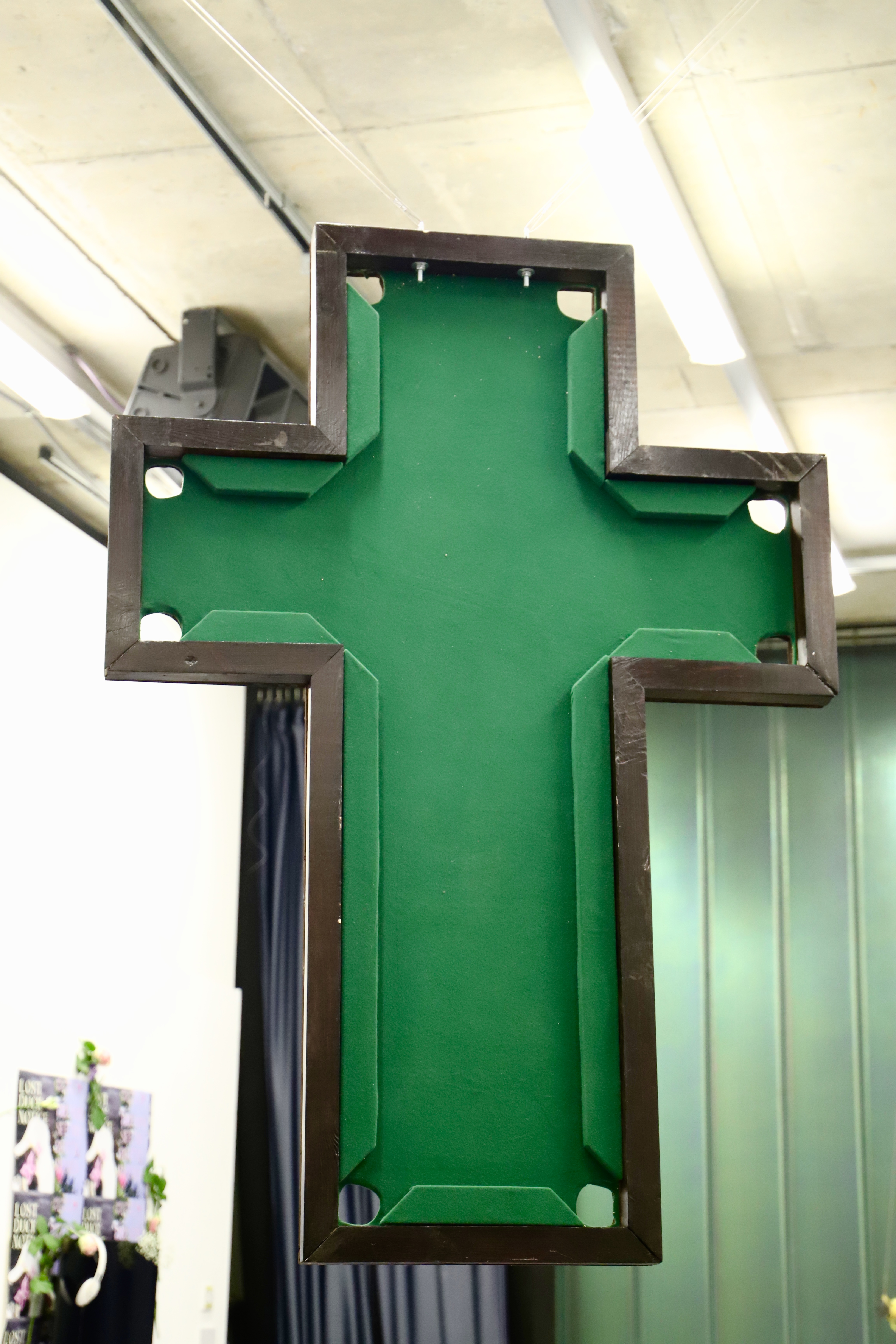
As such a busy body with a creative spirit I’m interested to know where Tegan finds time and inspiration to create work. With previous video pieces throughout her studies that were inspired by nights out like Last Weekend(2021), a montage of footage from pre-drinks, parties and exploring the streets late at night, “Human connection is where a lot of the work comes from. I feel like I’m building a mix of folklore of mine and my friends' lives.
"I feel like people don’t appreciate the present day as much as they do the past. I ask myself If I make something look old, how could that make someone feel? I hope it makes people want to cherish the moment we’re in.”
I ask whether Tegan finds it hard navigating the art-world a year out of art school. She first refers to that dreamstate she places herself in, that taking-risks while actively dreaming as “A good hard-ness. I don't think I'd want this to be easy, I don't feel like a dream is ever easy. You know what I mean? As an artist you have to have like 20 occupations at once, whether literally working multiple jobs or in creating the work. I just want to be able to facilitate the things I love doing. It’s my passion.”
See more of Tegan’s work on Instagram