




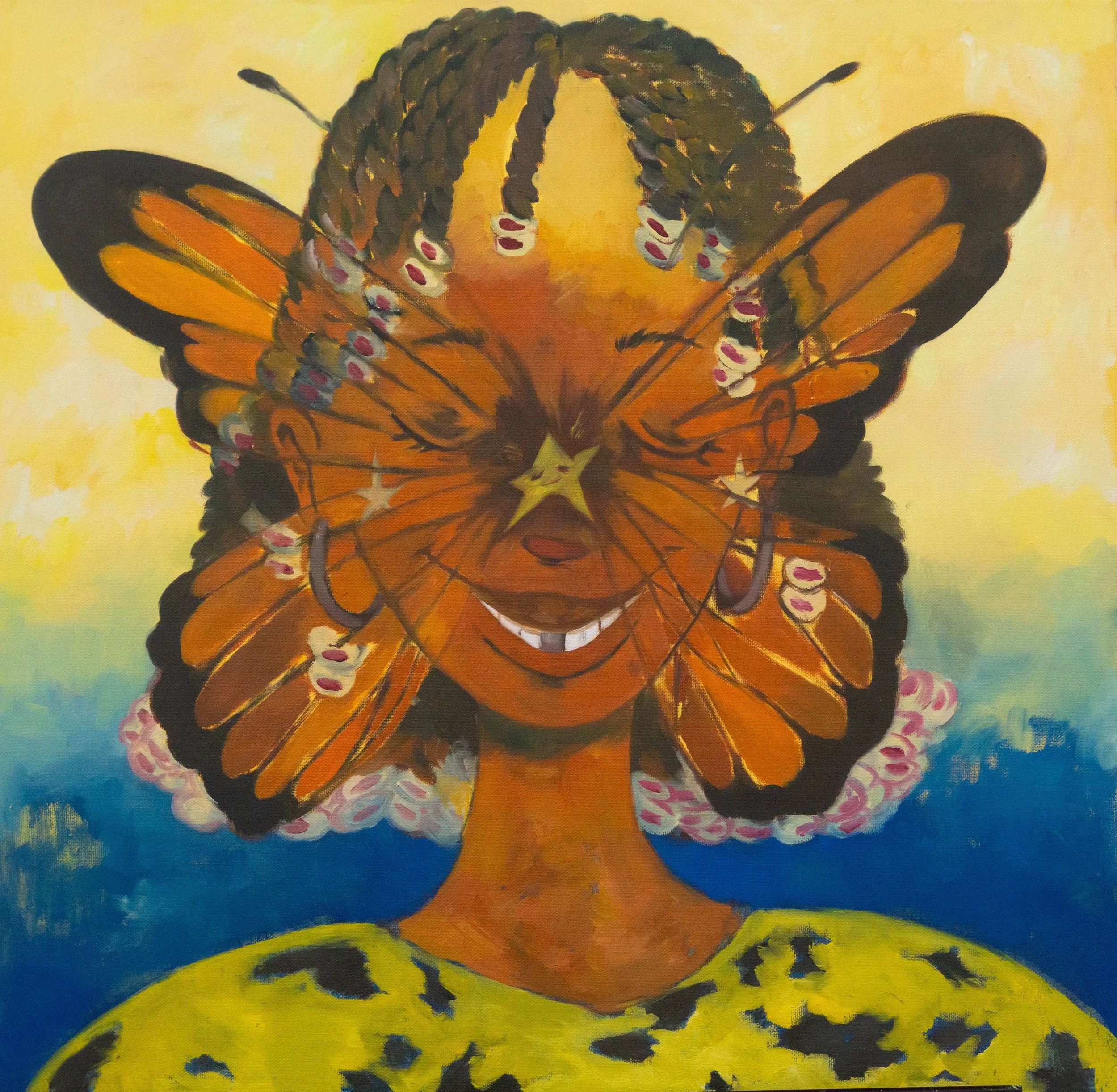
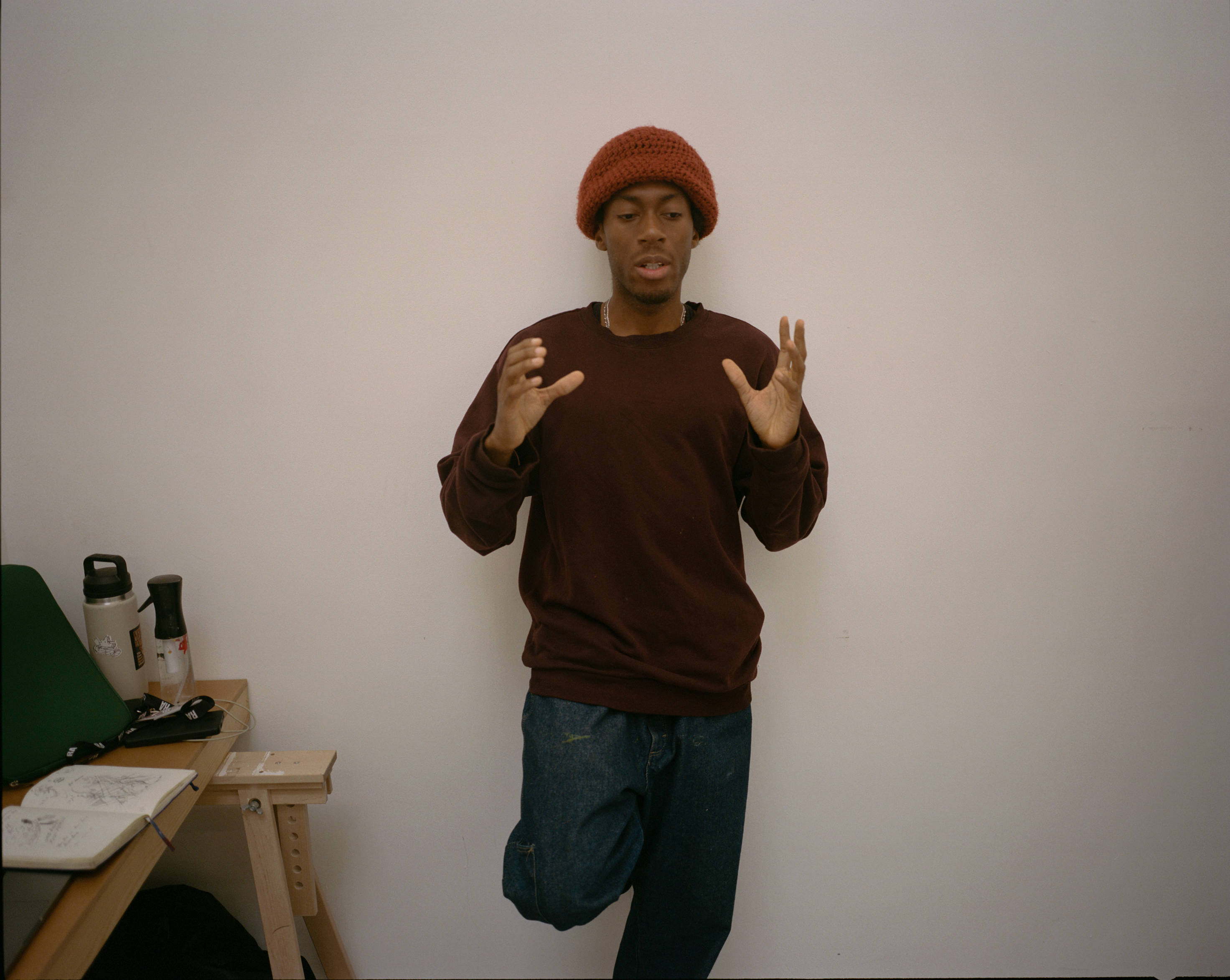
Deep in London’s heatwave, I hopped on the sweltering Victoria line (arguably the worst line to take in such conditions), heading to meet artist Obi Agwam at the historical Royal Academy of Arts. Obi, a Lagos-born, New York-raised figurative painter, creates dreamlike worlds on his canvas. Obi’s work is emotive and dreamlike in tone, reflecting Black American stories. He expresses himself and the perspective from which he meets the world, unconventionally he finds his paintbrush is led by a process of deconstructing his journal entries.
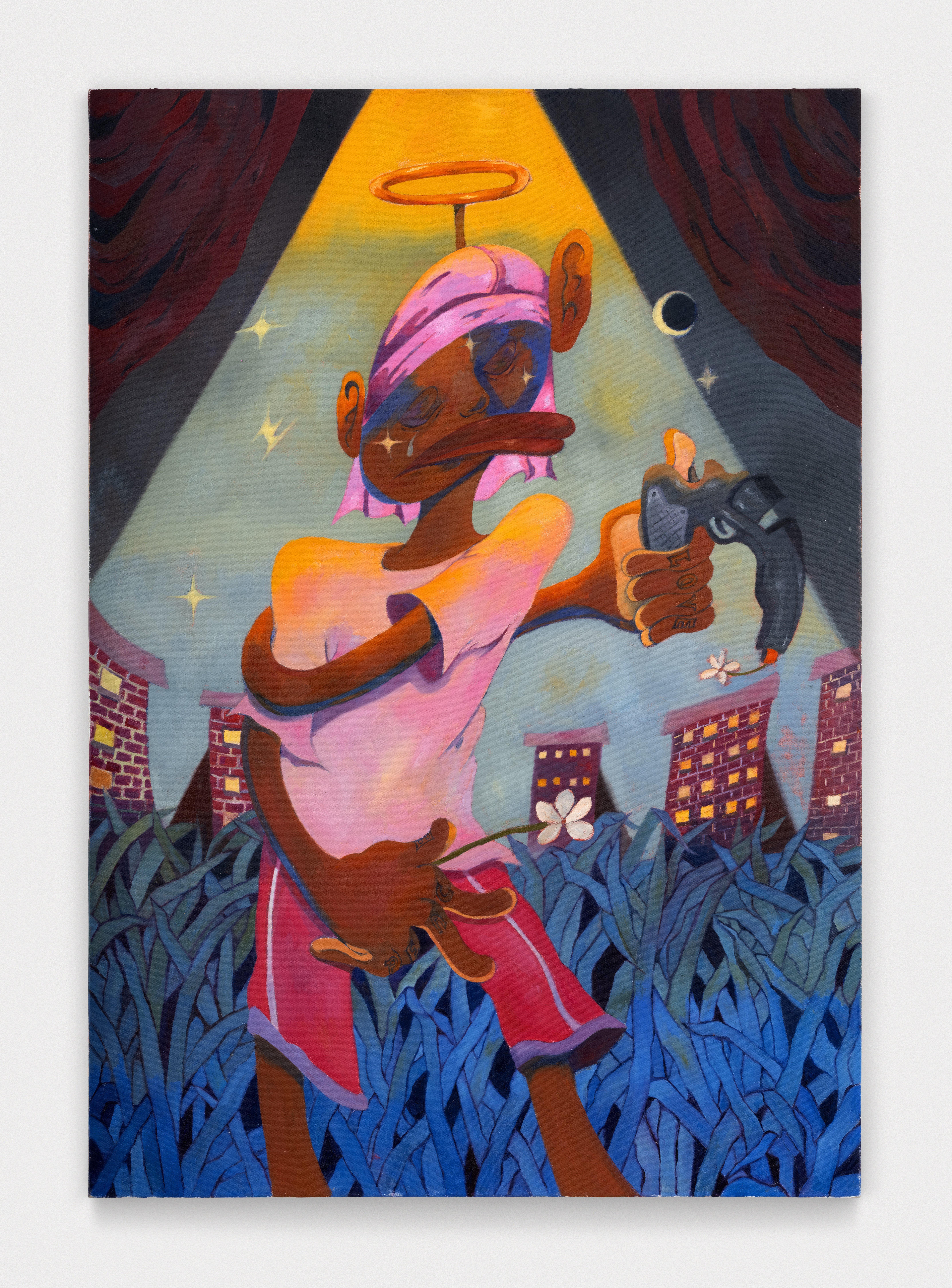
Agwam’s paintings become vessels of imagination and memory, inviting you into moments of nostalgia and manifestations of past places. The people seen on his canvas appear indistinct and visually uncanny, as their shape is inspired by how he connects to the racist history of stereotyped African-American bodies in animation. He reappropriates these histories into beauty, guiding them into an emotional world. When we speak in his studio, he is in the middle of hammering reference images onto his wall, 1960s Cartoons, 2000s R&B stills, and his favourite animes. The stories he shares on the canvas reflect a deep kinship with love, platonic, romantic, love for places, love for New York – just love.
On arrival at the prestigious Royal Academy of Arts, half flustered, I comedically bump into Obi as I exit the toilets. After quickly signing me in, we walk the corridors of Burlington House, walls adorned with sculptures and floors bustling with tutors. Obi passes a few faces, and they eagerly greet him with hellos. During our conversation, I tiptoe through his tight studio space, trying to keep up with his words while he beats a hammer to the wall, sticking reference images up, pins sat between his teeth.
I ask about his journey into the arts - if it’s been an interest from childhood, he chuckles candidly, telling me, “I would love to lie and say I’ve been painting all my life, but I haven’t; I started in university. Before that, I was always drawing”. It was a first-year intro class that pushed him into owning his own equipment, tools that would develop his interest outside of school hours, “I didn’t want to buy all the stuff (painting equipment). I said to my professor, “Can I not buy paint?” He said, “Yeah, you’re just gonna fail”. I went to the art store straight after that class,” and thank God he did. In his exploration, an early body of work began forming, shared on his Instagram, where an audience intrigued by the worlds on his canvas grew. With paintings exhibiting playful forms, ambiguous Black bodies with hallucinatory facial expressions or arrangements, it wasn’t long before he made his first sale - $200 for a painting- around age eighteen. He tells me this purchase set him up nicely for the month, considering he had no bills and little financial responsibility. More importantly, it signified the possibility of taking painting seriously: “When I got that purchase from Instagram, I was like, oh yeah, oh yeah, I can do this.”
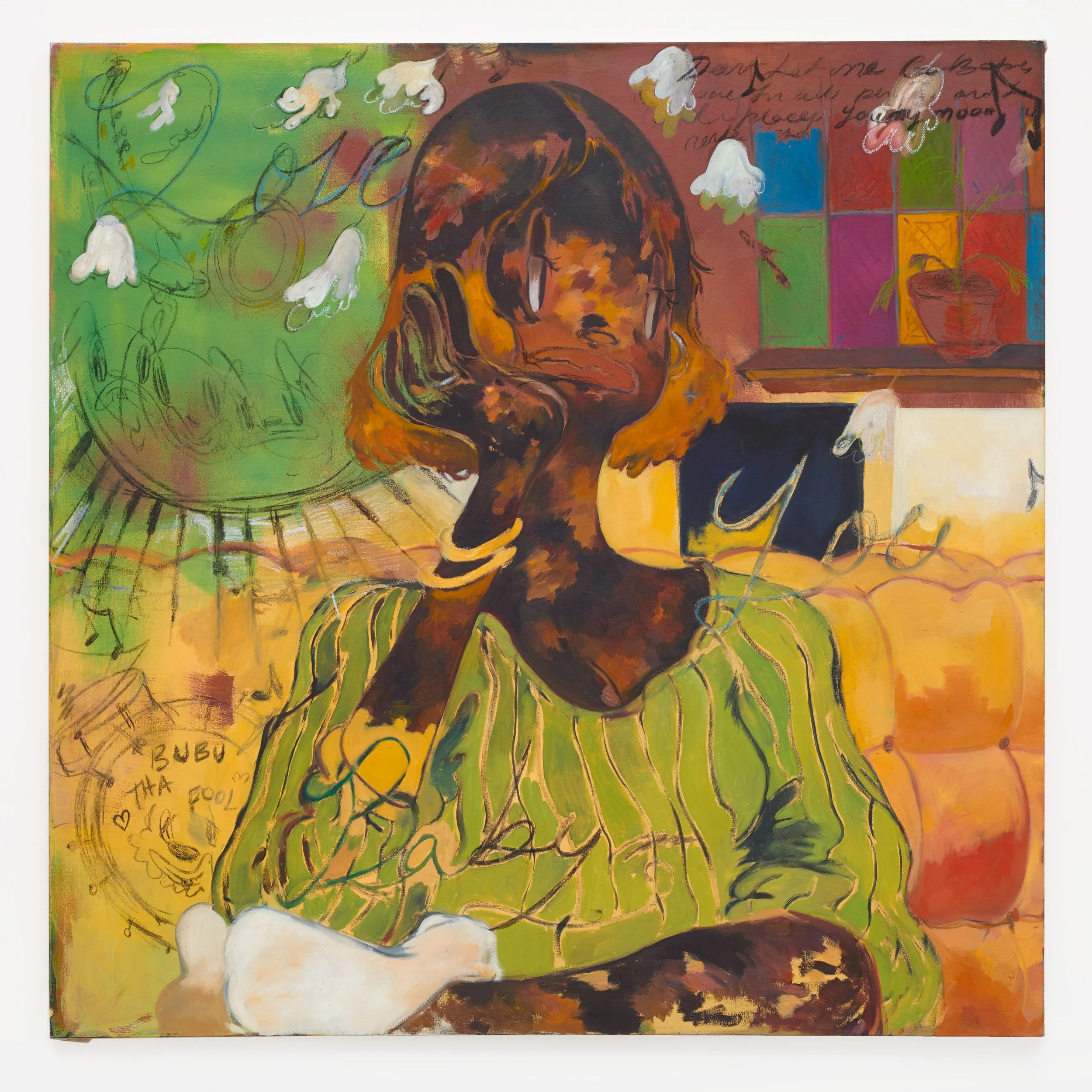
By this point in our conversation, Obi is on top of a chair, hammering away. My ears prick in my best effort not to miss a word, hovering around him, I observe the images in their new permanency. I’m distracted by a printed film slide featuring an animated Black man in a suit - lips enlarged, hot red in pigment, an imagination of Blackness perpetuated in the American mind of the past. I’m sidetracked from my pre-planned questions, and ask about it, “I forget the name” he stares at it a moment longer, attempting to trace its origin, “I have it on my laptop somewhere. From what I remember, it was a Warner Brothers animation about gambling. I consume a lot of media, so it's hard to pinpoint everything”. Similar enlarged lips, exaggerated hands or motion are seen throughout Obi’s painting. In this way, the image of Blackness created in the American mind is subverted, taking hyperbolised imagery and insisting that they have autonomy in his work.
Alongside intense body imagery, Obi uses flowers across much of his work. If it was up to me I would never leave (190x190cm acrylic on canvas), in which a figure is seen bathing in flowers, listening to their heart, “It comes back to being me on and off canvas. I love looking at flowers. It feels like the universe is the first artist and flowers are the first natural painting. Flowers carry cultural significance depending on where they are and how they are oriented. I hope when I'm old to be surrounded by flowers.”
When I ask him how his family feels about his life as an artist, whether or not they’re supportive at first, he says no, well, not at first. “Historically, being a painter hasn’t been a viable career path; there’s no money in it. Understandably, they had their concerns, a sentiment especially relatable to those of us of 1st or 2nd generation immigrant heritage, parented with concerns of climbing the ladder towards financial stability. “Most of the time, I would just be in my room making things. I don’t know if they necessarily understood what I was doing. Two years ago, I had an exhibition in New York. It was full of people, and I think that's when they realised this was something serious”.
New York is important in Obi’s work. You'll see buses he took throughout his teen years, frequented shops, bridges crossed, all things that ground his work to be of his city. “The backgrounds, environment, visual elements, really strictly come from New York because that’s where I’ve spent most of my time” Within the same moment a pin falls, I pass it up to him, “thank you” he continues hammering, “the work is based on my history, my emotional ties to the city”. Despite this, NY doesn't necessarily come across as an isolated character (at least in my view); it’s a dreamscape, a backdrop that evokes similar emotional ties to cities with rough edges, hustle culture and where diaspora communities are cultural stakeholders.
This is something Obi has come to witness since living in London, he described New York and London as “spiritually eerily similar” – then elaborated, “I think a lot of people, romanticise, at least I did, that if you go across the pond things will be different, part of that is true, but I’ve noticed between New York and London you’re meeting similar people going through the same kind of stuff.” He puts down the hammer to discuss the pride people have for their areas, the badge of honour it is to carry that with you. I describe it as marking territory, but Obi conveyed, “When you’re coming from certain areas, especially if it’s impoverished, it’s easy to be made to feel like you shouldn't be from there, that you shouldn’t be proud of this place. I think people bigging up where they're from is like an act of resistance towards that. It’s saying no, that’s my home, this is the place I love, I hold it dear to my heart”.
This reverence for place is strong in his paintings, even when re-imagining moments or locations; his characters, though indistinct, sit comfortably in these worlds. I ask how relating his journal to the canvas began, why he found this the best way to work – “I used to write poetry a lot, especially in high school. I was writing in an effort to be more open, emotionally in tune…I'm in the process of trying to understand myself better, and journaling is one of the ways to do that. In 2022, I figured out the concept of using my journal entries as prompts to paint. It became a way for me to be more connected to the work.” While talking me through his paintings, Obi tells me on the surface about their histories - old lovers, break-ups, friends who passed away, thoughts excavated on paper in a complex approach where his memories breathe and heal. In this way, nostalgia interrupts reality through the canvas:
“Emotions fill in the gaps our memories can’t, that in between space is where fantasy comes in, and I think that’s where my work sits.”
The paintings become essence, forgoing truth to an extent, favouring to honour time spent with people who may or may not be present in his life anymore. “If we go back in time with an objective lens, things might have been trash, but the good part (of a memory) is that we spent time with that person”.
I ask if unclear memories get any clearer through painting, if new parts of the puzzle are revealed in the process. He takes a long pause, “mmmmm… nah” (he laughs), “I think I'm most emotionally charged in the conceptualising of a painting, the drawing of it, figuring out what parts go where.” In the moment of putting paint to his canvas, it’s not autopilot but execution: “It’s less emotional. I’ll feel it most when I’m in my sketchbook; once it’s on the canvas, it’s go time. (while painting) If I start thinking about the sad stuff, ain't nothing gone get done, honestly”. I wonder if he ever finds it hard to paint, considering how closely his works relate to his emotional world: “The only time when I don't want to pick up a paintbrush is when I’m feeling the downs of an artistic career, the pitfalls. But I'm in such a state of joy when I make work; for me it’s second nature”, and when asked what drives him,
“I think every Black artist is a vessel for the spirit of Black creation. I think of those who picked up a paintbrush and didn’t have Instagram or the internet; they still dedicated their lives to it. When you enjoy what you’re doing, discipline comes naturally”.
Now looking towards the end of his time in London, Obi is absorbing the emotions of his successful London debut exhibition, “Love Letters to You and Me”, back in May. The show encapsulated his time under the Starr Fellowship residency, showcasing original paintings and his first sculptural piece, alongside live performances. "I wanted to try a bunch of things I wouldn't normally do; the show is a culmination of it all. Opening night was very special; it was a full house. We had musicians - a harpist and pianist, poets talking about love. It was also the first time I played music publicly as part of the performance, so I didn’t get to talk to people much, but lots of people resonated with the work, which was really cool.” Part of the exhibition's description was, if this memory were a person, what would it look like, encompassing his focus on the immediate conversation his work has with his memories. “That’s the main driver for the composition of these characters; I’m trying to scratch at how to visualise an emotion in a way that makes sense to me. Things in the paintings aren't exactly as they seem; the characters are cartoonish and animated, but they’re still scratching specific memories. I think my work is fun; I put an ode to the things I love, and so I want my paintings to be an extension of that love.”
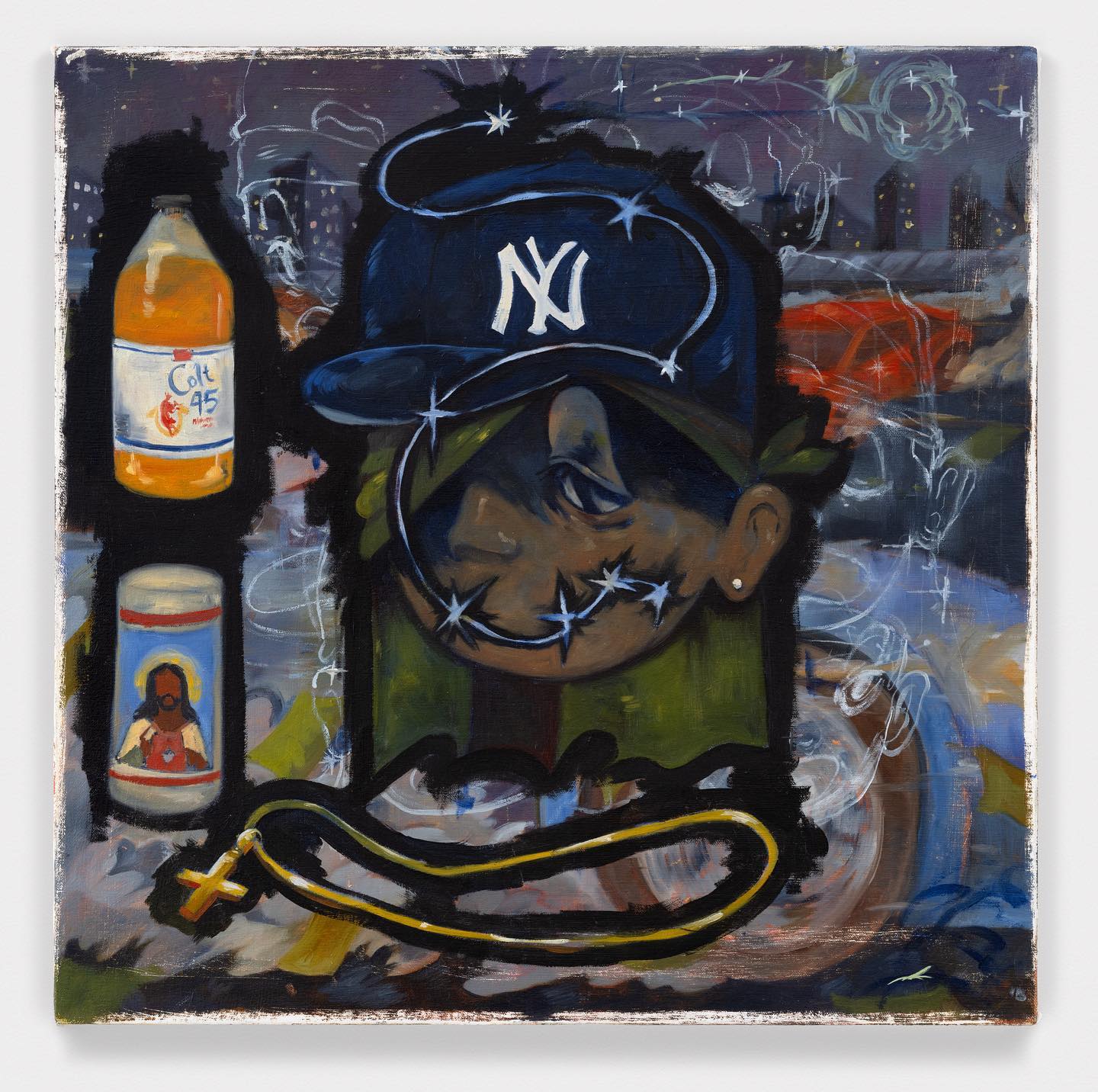
I ask, not in disregard of his hard work, but considering how he came to painting, almost accidentally falling in love with the medium, if he believes in fate, whether something cosmic is at play in his journey. “I think I do, but I think we make fate. With enough passion and dedication, you can do anything if it’s physically possible.
Sometimes we don’t want a goal; we want a feeling.
A lot of people don’t want money; they want freedom. They don’t want to be artists; they just want to express themselves. If you want to fly tomorrow, you can’t grow wings, but you can be a pilot”.


