



What does it mean to be here?
Sitting at the interface between the digital and the physical world, the video artist Ed Aktins’ work often involves cloning his body, sometimes naked, as a high-fidelity digital avatar. With life-like detail, from a single eyelash to a pore on the forehead, Atkins’ avatar flirts with naturalism, realism, idealism, and illusionism all at once. Atkins teases us with the question, is his avatar real or fake? This question is complicated by the fact the viewer knows that Atkins is a real person with a real body. Unless his digital clone gains self-consciousness, it can only be as real as Atkins himself can ever be. The avatar can never be real when its link to Atkins is severed.
In anthropology’s embodiment theory, the mind and body are not separate entities but a prerequisite pair for consciousness. Without a body to interact with the physical world, it is impossible for the mind to make sense of itself. This is what separates artificial intelligence from humans as self-aware beings.
To be real, is to have the embodied experience that makes us humans.
In Jean-Paul Sartre’s landmark philosophical novel Nausea (1938), the wandering writer Antoine Roquetin grapples with feelings of meaninglessness in the fictional port city of Bouville. In between his episodic existential dread that famously climaxed under a chestnut tree, Roquetin finds communion in others at the cafe.
Though where would Roquetin find this solace today? Contemporary cities are mall-ified for consumption, authentic public spaces such as the high street and plaza are disappearing en-masse. Our present is further complicated by a superimposition of the digital onto the physical, where social interactions in real life are constantly skewed by the smartphone.
•••
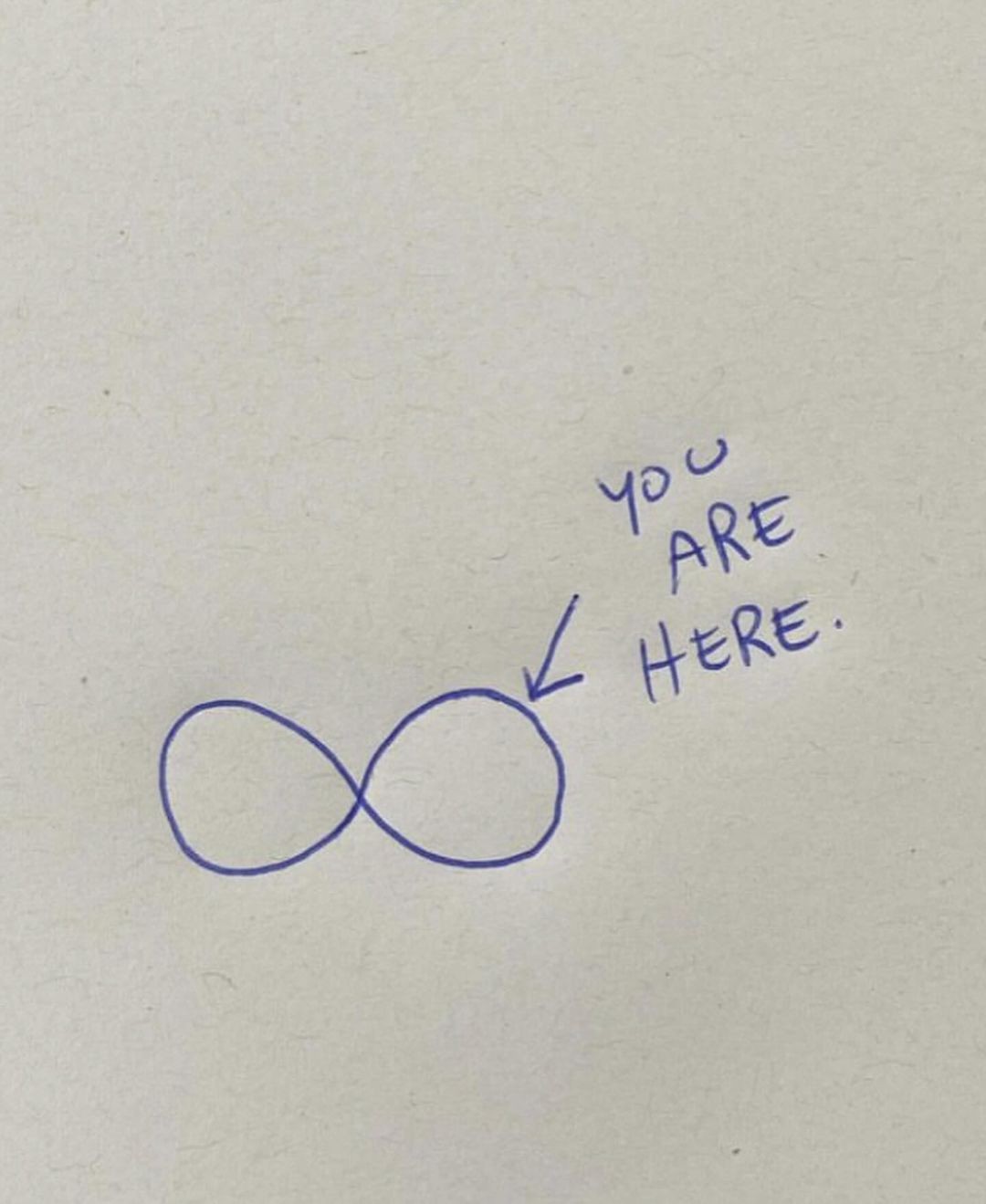
You are here, says the shopping mall digital directory.
Lost and exhausted, you are elated to find the large chestnut tree marking a small atrium. Amongst wall-mounted screens and a faceless crowd glued to their handheld screens, flocking to shops, buying meaningless goods, it is the only resemblance to the outside world.
You rest at the bench under the tree’s canopy, soaking up the residual sunlight first filtered through the metal-framed, green-tinted skylight, then past a net of lush, green leaves that somehow manage to flourish in the air-conditioned and artificially-lit mall. Hands empty, you instinctively reach for your phone in your pocket and begin swiping aimlessly.
The roots of the chestnut tree suddenly sink into the ground just beneath your bench. You cannot remember it as a root anymore. Words vanish and with them the meaning of things, the ways things are to be used, the feeble points of reference which people trace on their surface. You are sitting, stooping over, head bowed, alone in front of this black, knotty lump, entirely raw, frightening you.
Where are you? What is real?
The shopping mall is a simulation of the ‘real’, it is a mock social space where commodity exchange supplants social interactions. Framed by the architect and theorist Michael Sorkin in Variations on a Theme Park: The New American City and the End of Public Space (1992), the shopping mall has become a microcosm of the North American city in the 1990s. In the mall-like city, “identity is momentarily stabilized even while the image of a future identity begins to take shape, but the endless variation of objects means that satisfaction always remains just out of reach”. In these commodity driven societies, identities become built upon a constant flux of consumable comings and goings, removing one’s grounded self-realisation through authentic social engagement.
Whilst Sorkin’s critique is North American and from three decades ago, clear similarities can still be drawn in London’s contemporary urban landscape. In the face of neverending austerity and the retreat of public ownership of plazas, ‘public-private partnership’ started covering the provision and management of such spaces and has resulted in private security and active surveillance sterilising authentic and organic human interaction. Equally, soaring rents and the rise of online shopping has brought about the slow death of the high street, replaced by a simulacra of gentrified market squares, Aperol Spritz and craft beer gardens, rebranded workwear, and curated public programmes.
The struggle to reach authenticity in the Sorkinian city space is now further complicated by the superimposition of the digital landscape onto the physical. The smartphone rewrites the dynamic of all public spaces alike.
The early-day internet’s promise as a democratising force, decentralising communication and information production, and hence challenging traditional institutional structures has without question been dismantled by corporatism. Via centralised ownership of key social media platforms, interactions online are shaped by algorithms, and behavioural norms are moulded by UX/ UI designs that encourage short attention span consumerism. Via the handheld smartphone, the online now bleeds into the offline 24/7, making the two inseparable and indifferentiable. Human to human interaction has not only become consumption driven but also disembodied.
A walk in the park is constantly interrupted by push notifications, day-to-day decisions are advised by A.I. chatbots, public eye-contact is frowned upon, and spontaneous conversations with strangers are no longer appropriate. When the city’s physical space and social interactions are regulated and scheduled via the app, how can anything be real and authentic anymore?
•••
Nauseated, you lift your enormous weight up and away from the bench. Temporarily relieved by the amazement of how the entirety of your upper body is supported by two thin, bony legs, you force yourself to walk, exit the mall, head to the car-park-converted-sauna just down the road. It will be hot, and you do not exactly need more heat on this scorching summer day. But at least there will be familiar faces, and there will be no phones.
•••
During his existential episodes, Roquetin routinely returns to an unnamed cafe in Bouville. It is in this cafe he expects to find regular local patrons, familiar staff, and predictable music that soothes his alienation from humanity and ultimately his growing awareness of the absurdity of life.
Despite Roquetin’s well illustrated disdain for the achievements of bourgeois humanity, signified by oil portraits hung inside the Bouville town hall, ranging from military commanders to industrialists, he instinctively seeks and finds temporary relief in the communion of souls in the city’s everyday spaces. It was at the cafe that he found companionship amongst other humans that is so instinctive and raw.
•••
You look at the thermometer on the timber-clad wall, it is 105 degrees. You are bathed in sweat. But you are amongst others. No phone in sight, your nausea pauses, for as long as you can stand the intense heat.
From 45 in 2023, the number of the UK’s Finnish-style saunas more than doubled to above 100 in 2024, and are projected to grow to over 200 by the end of this year. The community sauna’s rise as a contemporary third space in-lieu of Sartre’s cafe is symptomatic of the times we are in. In the contemporary mall-like city, where urban spaces are not only commodified and undemocratic but subsumed by the digital chokehold that constantly distracts and stifles organic social interaction, society’s fringe search for communion and connection converge at the many locally-run, non-for-profit bathhouses that are phone-free by default.
The disassociated present has rendered us as versions of Roquetin, alienated both bodily and psychologically, wandering aimlessly in search of relief.
Whilst the sauna movement is an encouraging method of reembodiment, it should be read as more of a question and less of an answer. From political resistance to consumer activism, the making of more authentic third spaces and by extension, public spaces, will have to be a collective effort instead of isolated endeavours.
What does it really mean to be ‘here’?
To be real, is to consciously choose the embodied social experience that makes us humans.
_____________________________________________________________________________________________________________________________________________________________________
Bio
Alfred Yatlong Yeung is an architect and writer, and an incoming Design Researcher in Residence at the Design Museum in London. He has been involved in major civic projects including the shortlisted British Museum Western Range proposal. With works exploring cultural identities through a blend of fiction and critical essays, he has written for numerous architectural media including the Architectural Review, Architects’ Journal, Open City and C20 Society, as well as various London-based art magazines. Alfred is also an alumnus and mentor at the New Architecture Writers programme. He was recently shortlisted as a AJ100 New Talent.