



I feel a new, troubling submission to social media lately. Not that it is addictive or corrosive to my mind; these sentiments are old and greyed. But that it is coming at me, rather than from me.
The routine is the same. My phone screen lights up and with ease I’m fed advertisements, AI-generated reels, and influencer campaigns. My hand ushers one piece of content after the next. The appendage moving back and forth with such steady rhythm, in time I’m sure to burn a hole through the screen. One to climb down into and lose myself for a few minutes. If not a few hours. I look at anonymous faces, old movie clips, and quotes from B-list actors. Now and again, I flick open the comment section. All the handles are unrecognisable—a bunch of strangers. I am sure to stay very quiet, spending my time slipping between people’s profiles and strangers’ reels, leaving no trace but the traffic Meta catches.
In truth, I’m not the only quiet one on social media lately.
Very few friends post anymore. Gone are the days of seeing someone’s latte art, Christmas morning spread, or celebratory second-year anniversary photo. The classic boyfriend reveal is near extinct. Recent data reported by the BBC shows that nearly a third of social media users post less than they did a year ago. It seems people are more hesitant to upload than ever before, feeling far more comfortable consuming content, then creating it.
When asked why, many tell me over the pub table or voice note that it feels cringe. In the New Yorker article “Are You Experiencing Posting Ennui?”, Kyle Chayka takes this a step further, suggesting that those who do brave it (who push past the cringe and click share) are later met with a “vulnerability hangover”: an instant sense of regret or shame after uploading something personal. Recoiling from this unpleasantry, more users are retreating into online voyeurism.
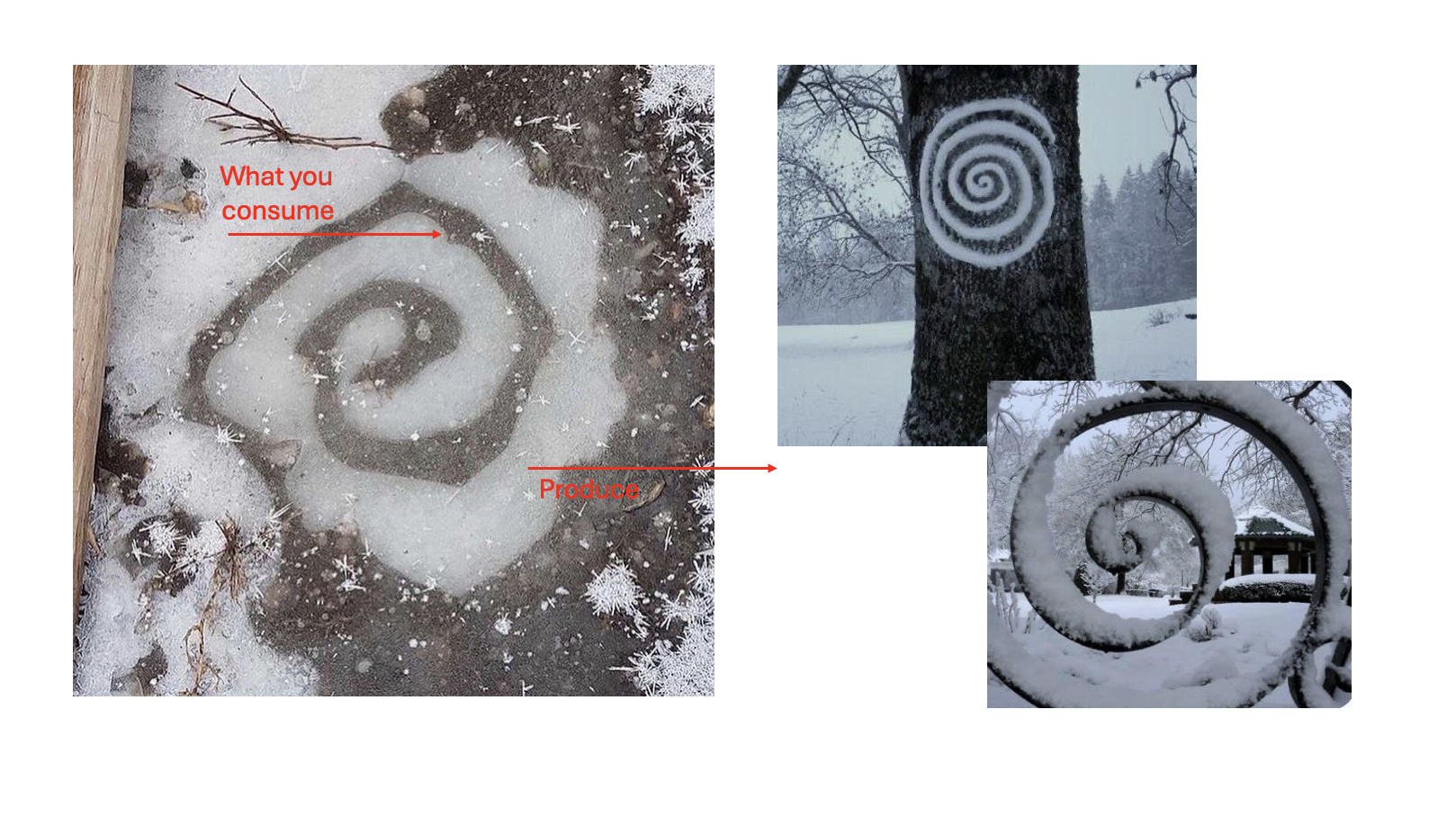
Regarding social media, they’ve been ushered off the stage and into the audience. What a loss that demands to be taken back. Because to only consume and never create makes up only half of social media’s purpose—leaving an unsatisfied itch on the brain. What follows is decay: social media collapses into a unidirectional form of entertainment. Like television, only this time brands are the directors. To help develop a sense of autonomy or control, we need to campaign to produce equal to what we consume online.
It's a task which proves more difficult than anticipated. The reasons for this shift are composite. On the one hand, posting “sweet-nothing” moments can feel crass in contrast to current geo-political tensions. That is, including but not limited to international and internal armed conflicts, such as those in Ukraine, Sudan, Israel, and the Occupied Palestinian Territories. As well as parallel famines, mass deportations, spearing political polarisation, and record-breaking environmental crises.
During the 2020 Black Lives Matter Movement, #BlackoutTuesday consisted of social media users posting a black square to show allyship. A movement quickly under fire within twenty-four hours of its inception—not only for being empty in effort, but also for flooding out essential news coverage. Here, the Attention Economy was brought to the fore—postulating that the internet is in fact not infinite. What we post takes up mental capacity in people’s minds. As though pitching a tent on valuable cognitive real estate. Many of us started to ask, “Is what I’m posting really that important?” A hard question to square whilst flipping through recent holiday snapshots or end-of-year round-ups.
Of course, not everyone is dissuaded from posting because of this anxiety. Others simply feel that posting is just pointless; their images are bound to be drowned out by algorithmic preferences, sex-bots, and AI-slop. For every one photo I see of a friend on my feed, five are unsolicited images or reels from random accounts or brands. This noise is only set to get worse: in a recent report by SEO firm Graphite, more than fifty percent of English-language articles from the past five years were found to be AI-generated.
When it comes to AI content, one thing for certain is that we are just getting started. As it continues to bloom like fungi across social media, space for human engagement will be squeezed out. In The Atlantic article “Maybe You Missed It, But the Internet ‘Died’ Five Years Ago”, Kaitlyn Tiffany explores Dead Internet theory. It’s a conspiracy theory, and like so many others, too slippery to pinpoint an origin or date of birth. But its key argument is that organic human activity on the web is being overrun by algorithmic preferences and bots. Today, this notion has shifted away from being hysteric online rhetoric to fact, with even the CEO of OpenAI, Sam Altman confirming its legitimacy.
So, whether it feels cringe, crass, or simply pointless, the end result is the same. Users are increasingly engaging with social media in anti-social ways. The irony is that despite technology’s appetite for relentless progression, we’ve been here before. In the early days of the internet was Web 1.0, also known as the static or “read-only” web. Here, readership was open to the public and contribution was limited to authors who knew how to upload. There was no comment section, reshare button, or direct message service. Unless users cared to gather around the monitor with their peers, it tended to facilitate a private act of learning. Meaning the internet functioned like a digital library, stimulating but solitary.
Then Web 2.0 launched, also known as the participatory or “social web”. With it, engagement became possible. People went from passive users to active participants. With ease, anyone could upload content, comment, like, or reshare. Through this process people began building layer upon layer—enriching not only their own minds but the internet itself.
In 2001, former financial trader Jimmy Wales and web developer Larry Sanger sought to harness the ebullient co-creative energy they witnessed online, shaping it into a community-run, peer-reviewed digital record of knowledge. And so Wikipedia came to be. Other early webmasters were equally excited by this sense of online collaboration. In 1996, Carl Steadman, co-founder of the early web magazine Suck, talked to Time about the parallel between online alliance and intellectual liberation:
“I think the importance of interactivity in online media can’t be overstated…when I can cheerfully scroll past the cyberpundit of the moment’s latest exposé to the discussion area that features the opinions of true experts… I’ll feel I’ve finally broken free.”
It’s a beautiful sentiment. One which captures a euphoric “call-and-response” largely absent from today’s comment sections. Instead, many users leverage this space as a pasture to soothe their ego or farm for likes, rather than initiate an open-minded conversation. The users who fail to be controversial enough and capture any engagement are left dangling in space—like a passerby speaking to themselves in a crowd. Which is equally hard to experience as it is to witness.
Too many of us sit alone consuming endlessly what’s out there without any sense of entitlement to step in. To create, or take up space, or play. Regressing back into the scaffolding of Web 1.0—only worse. Because this time it isn’t due to a lack of knowledge or technological limitation, but a rising social norm that social media is no longer for us.
This great death or robbery or exclusion does not have to be the case. At the beginning of 2026, writer Róisín Lanigan declared in The Guardian that her New Year’s Resolution is to post more, stating: “I wish we weren’t too cool or too bored or too frightened of being judged to invite each other into our online lives a bit more”. Because if we don’t, we will only be edged out. Made to sit in front of our screens passive and irate, unable to see ourselves in our creation. Perhaps in this regard, a “take back the internet” movement is needed.
Key to this is participation without recognition. The goal cannot centre on gaining followers, viewers, clout, brand deals, or likes, but simply to exercise the web as an outlet of socialised play. Because if we do the opposite, it’s only a matter of time until people once again see sharing as a zero-sum game. That is, in metrics which are unsatisfying or embarrassing to them. We have to kill the voice that says “influencers can post because it’s their job and they make money from it, and thus it is reasonable”.
Reasonability cannot begin and end on money. Post for the sake of creation, to simply say “Look! I’m alive”, to make something beautiful, or silly, or useless in every other way except that it made me happy to do so.
On very long days, when my screen time has hit a worrying number, perhaps the answer is not to toss my phone away, only to pick it up a few minutes later—but to turn and face the music, engaging with social media instead of letting it wash over and ultimately drown me out. That is, to use it as a site of expression: to collage photos, curate playlists, and record the person I may never be again. To, as writers Maria Farrell and Robin Berjon call it, rewild the internet and its ailing ecosystem, treating my profile like a little garden the way we once did on MySpace. And in doing so, we may find that the internet does not have to rain down upon us. There was a time when social media felt like it came from us—like a life force. We can return to that. But the first step is to push back and post more.