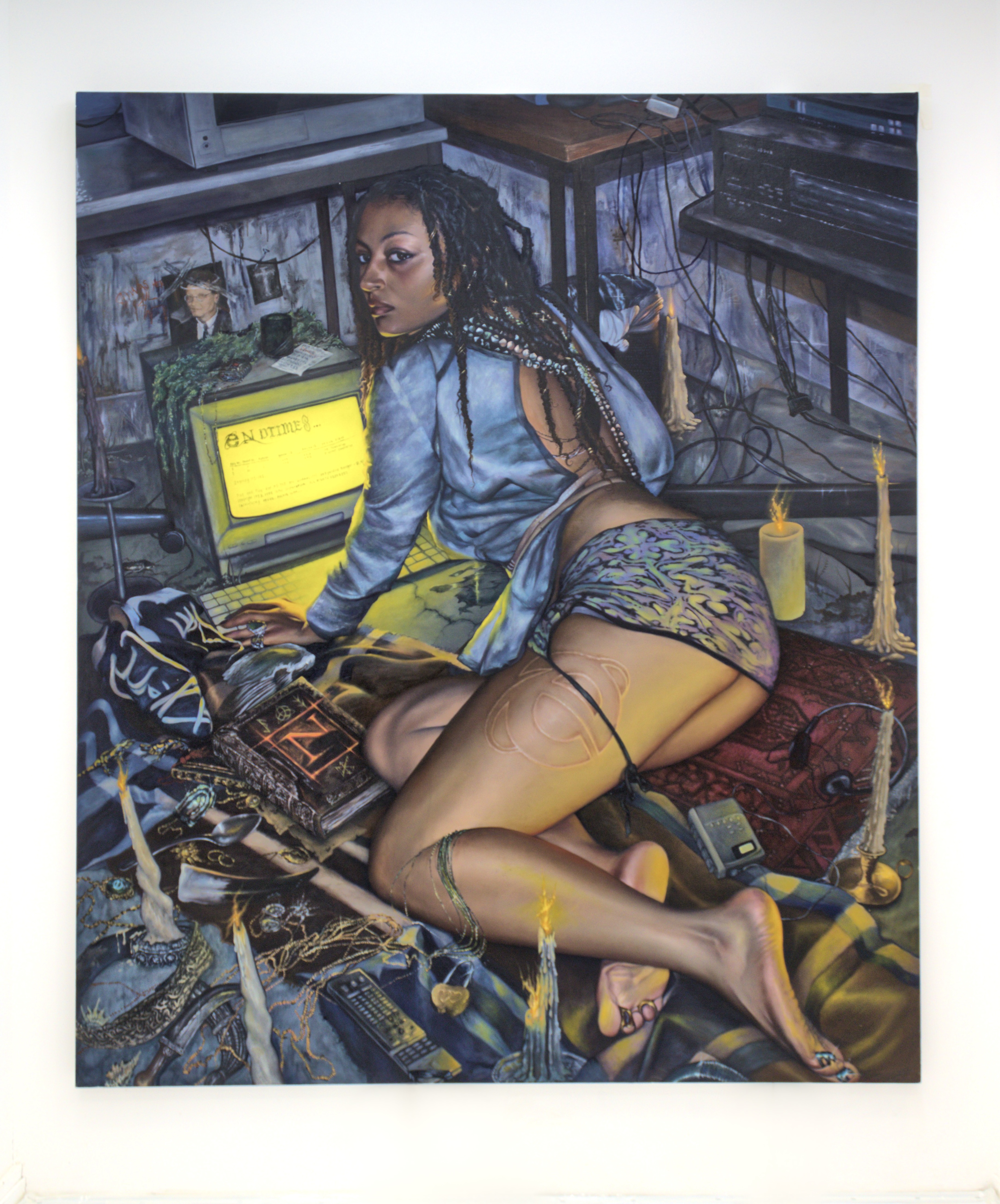
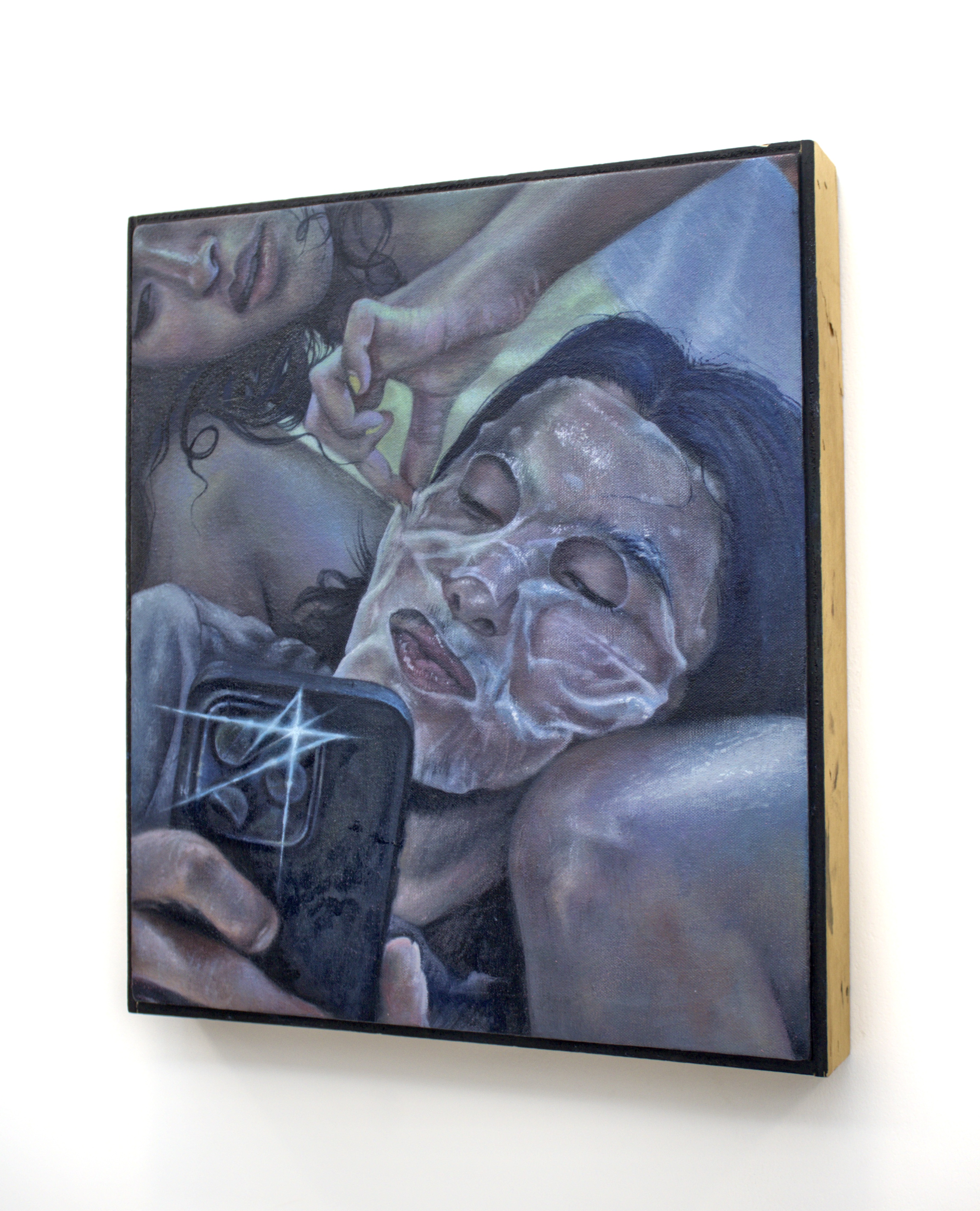
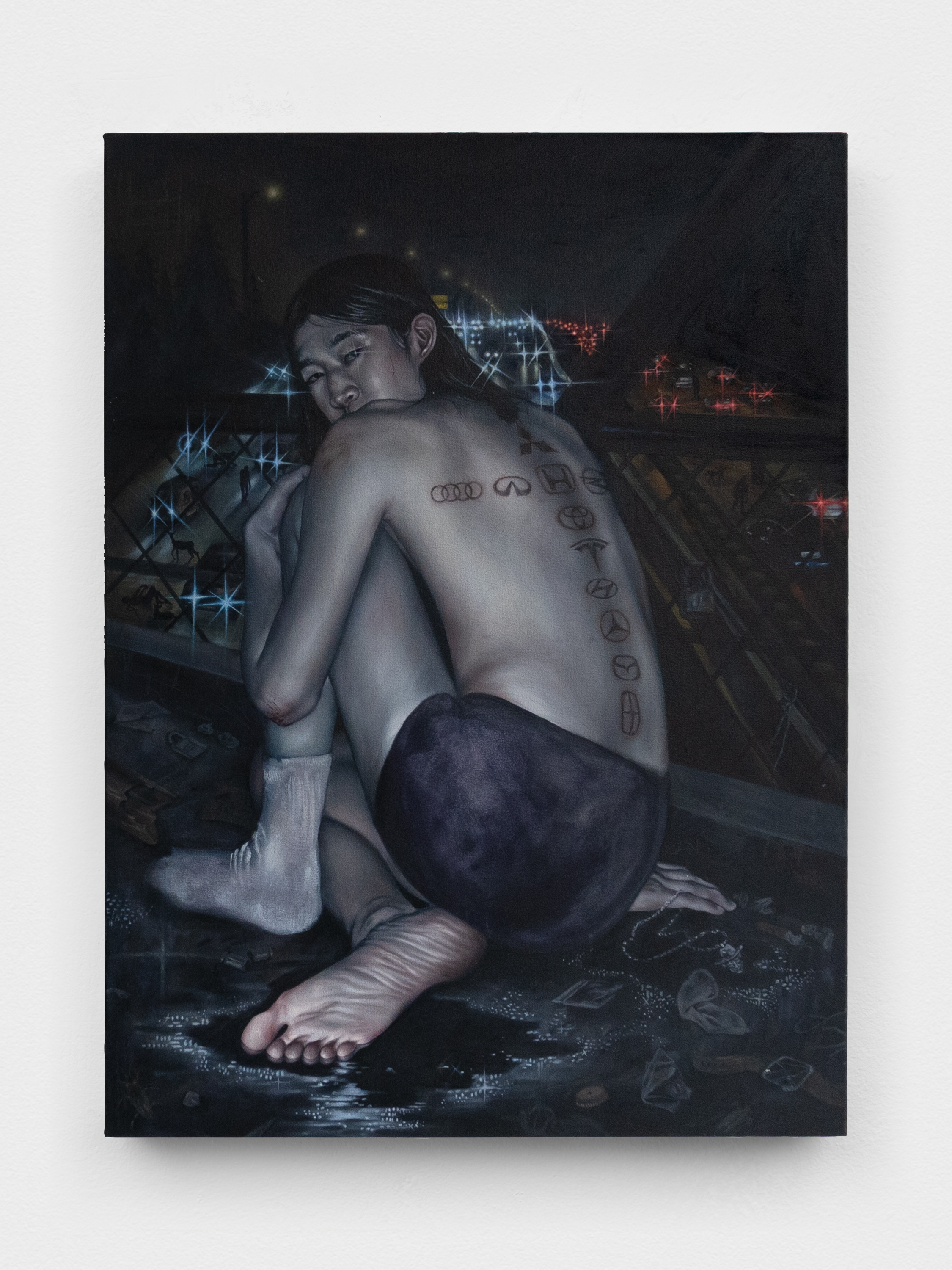
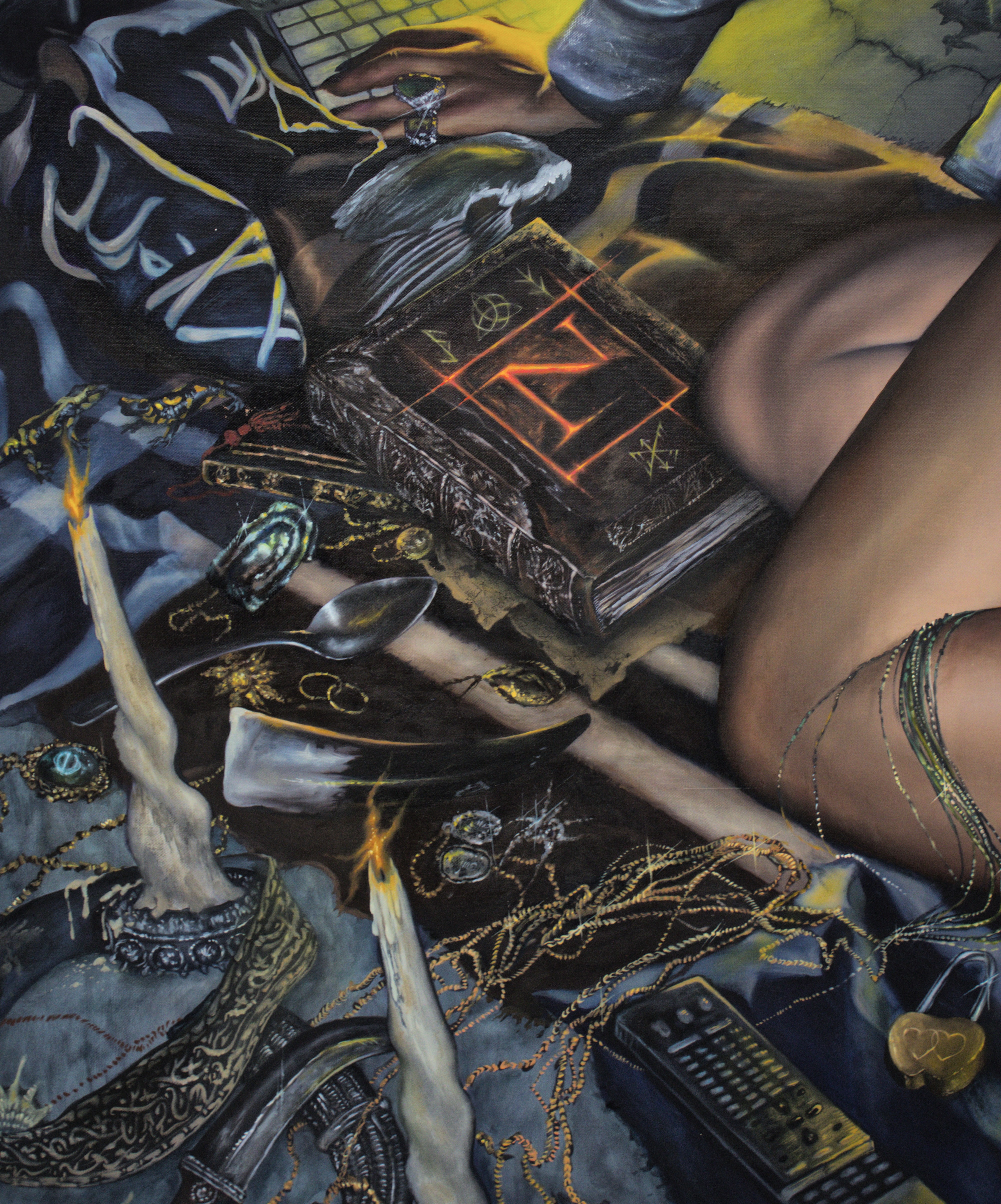
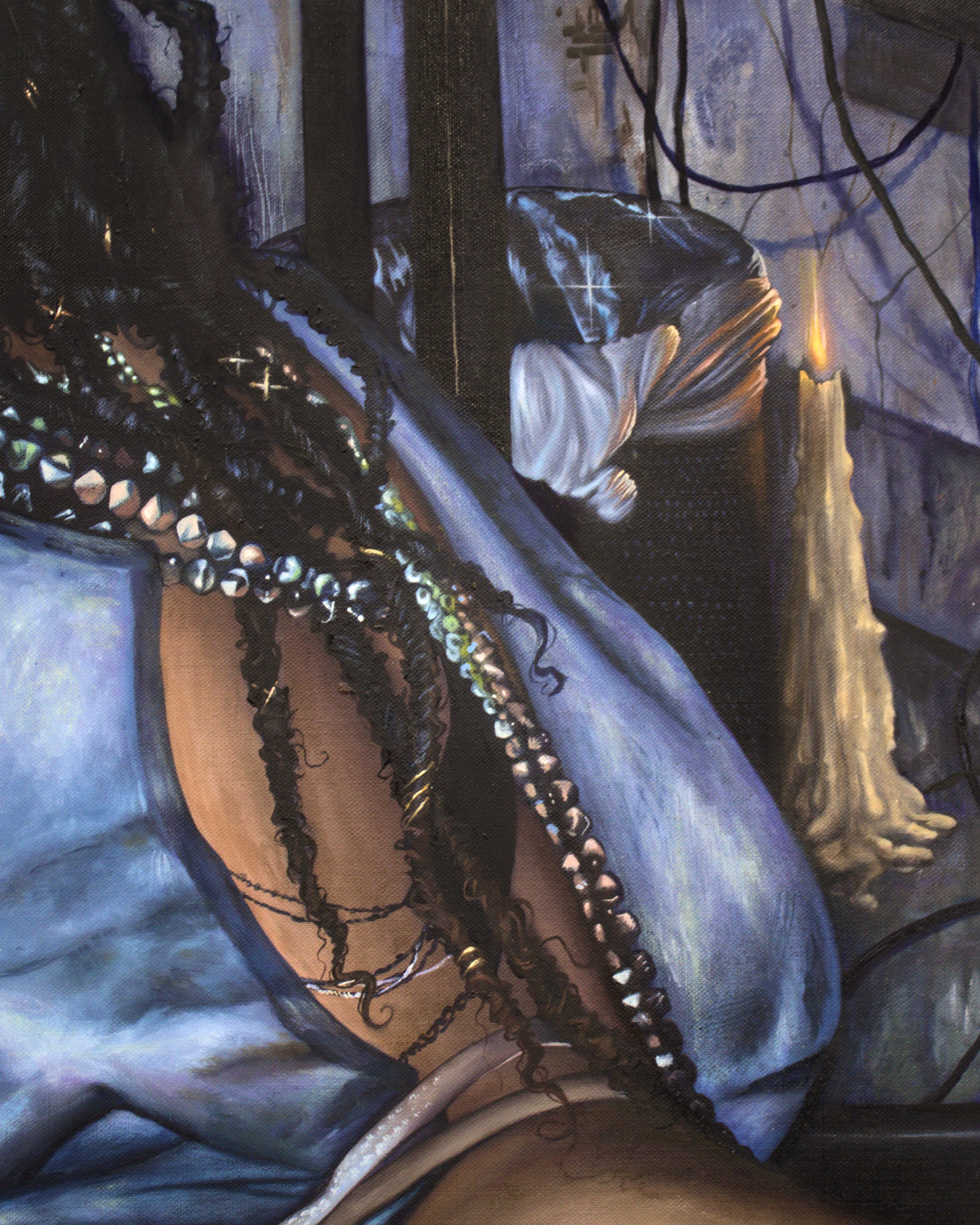
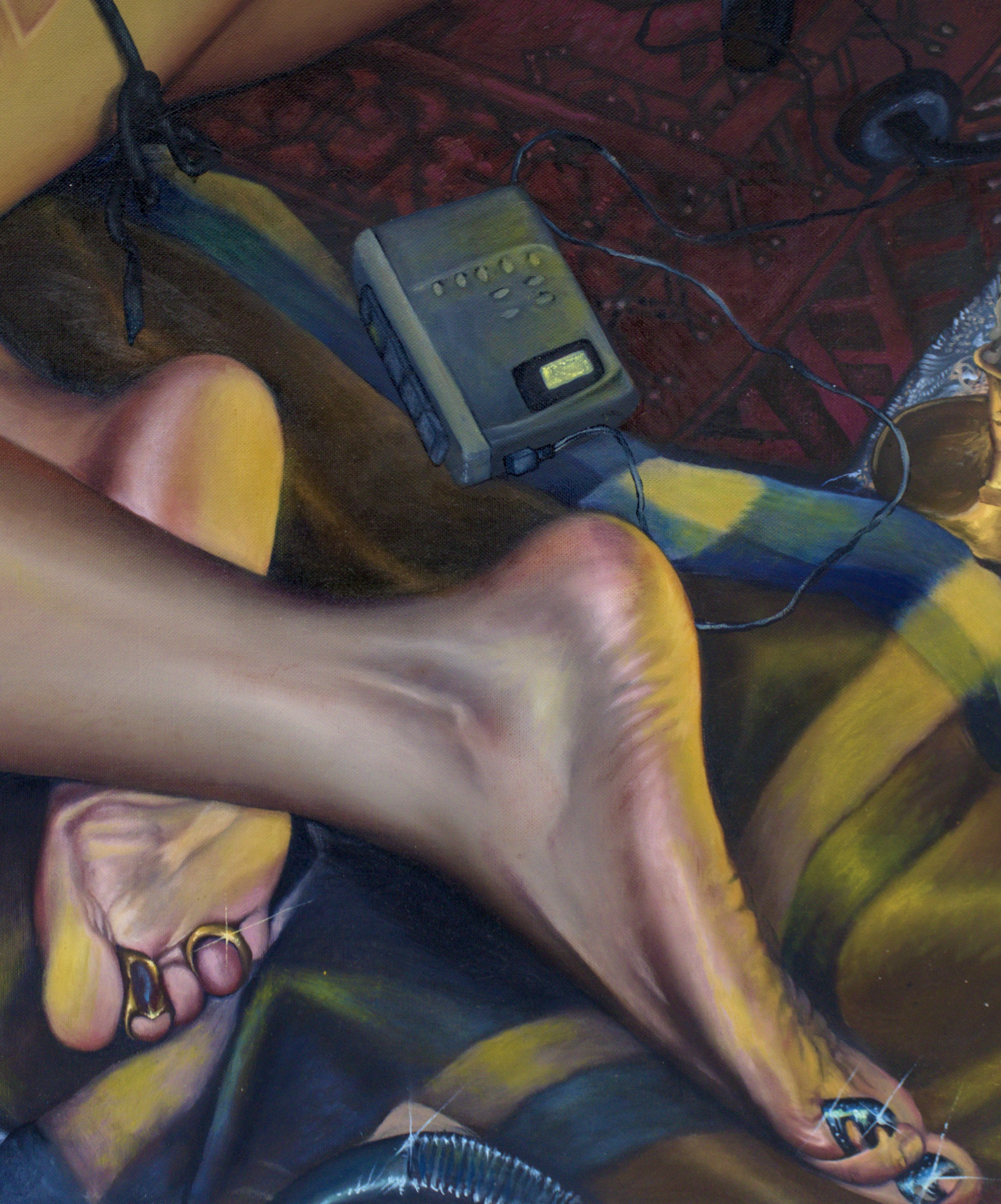
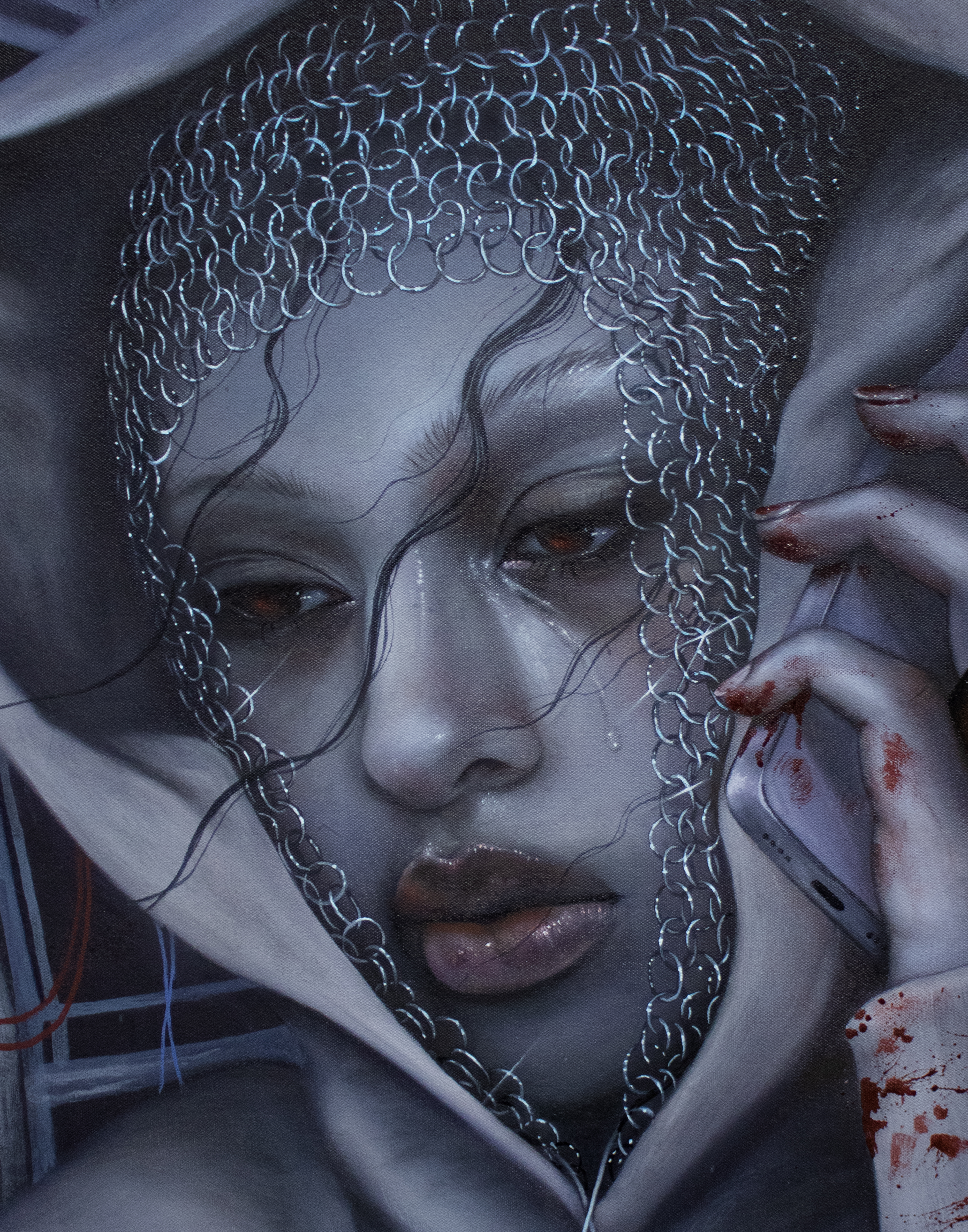
Despite her post-apocalyptic aesthetics, Echo Seireeni isn’t a pessimist. In her latest exhibition, Data Lake, Seireeni shows figurative paintings replete with the imagery of tech doomerism; across the largest canvas, a wary female figure is stretched out in front of a PC and a Bill Gates shrine, the internet explorer icon branded on her thigh.
Seireeni constructs an alternate world littered with the debris of our current one, yet augmented by the body language and glossy sexuality of advertising. Her contention is that technology has fundamentally changed what it means to be human, but far from the anti-humanism of today’s tech elite, she prophesies that care and cooperation will survive the technological apocalypse.
The show appears at Harlesden High Street, Jonny Tanna’s north-west London gallery space with a curatorial programme (and postcode) that flouts the artworld mainstream. Nearing the end of Data Lake’s run, Echo chats with Pilot about her creative practice, AI slop, Wikipedia deep dives, and why–despite the state of the world–she remains optimistic.
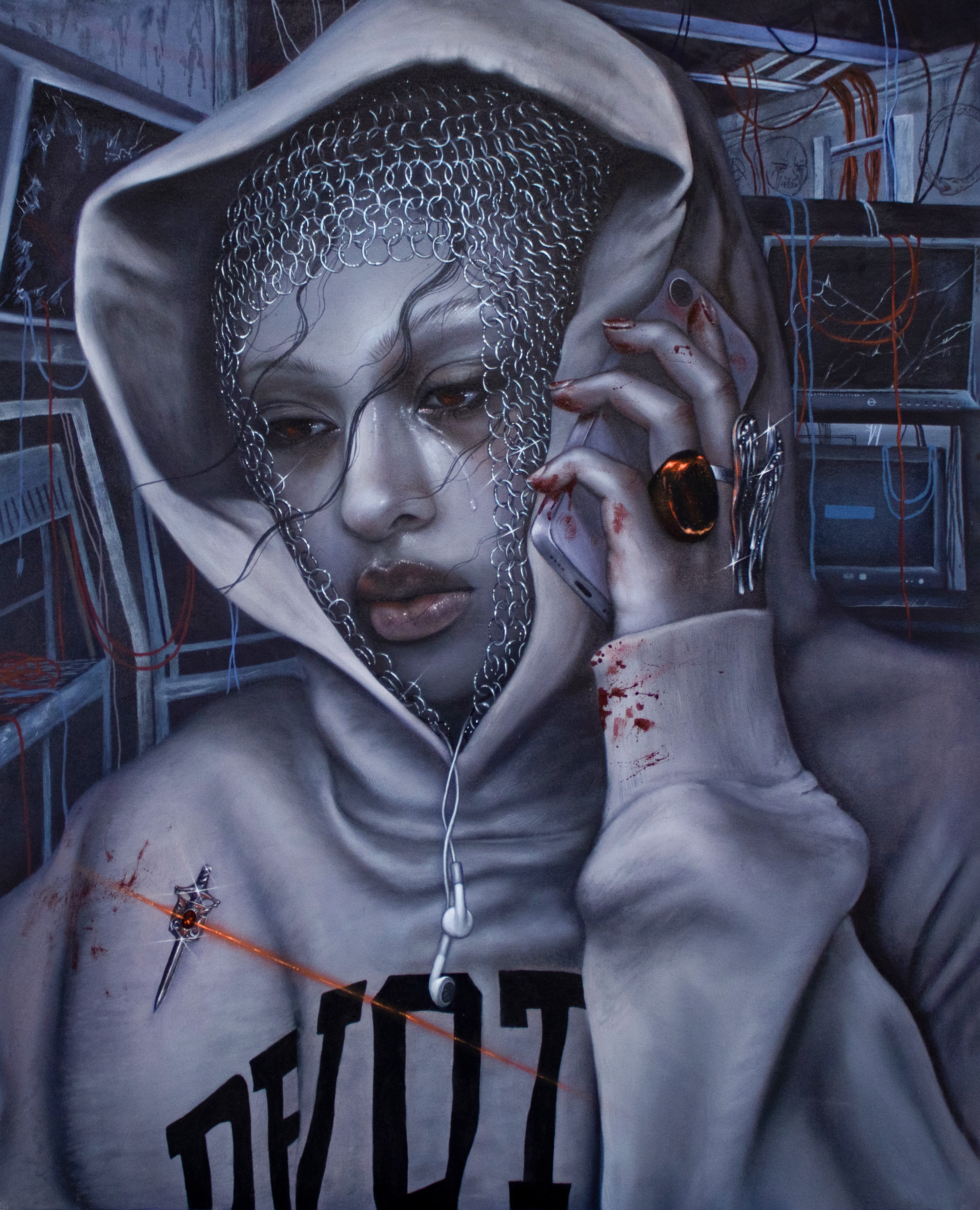
The first thing I want to know about is the universe that these paintings exist in.
Well, I would say that they exist in a space that blends past and present. So they're fantastical in form, but all of the signifiers and motifs and the images are things that we recognize from day-to-day life. One of them is very specifically set in 1993.
The Browser Wars?
Yeah, The First Browser War is meant to be set in 1993, so I put a lot of signifiers in it that are supposed to clue you into that time period. But other ones blend the past and now, like the one with the glove and iPhone. It’s supposed to be a space where we can tell tales about why things look and feel the way they do today, using the kind of imagery that we would’ve had in the past.
I thought that the feudal imagery was really interesting because of the way that people now talk about big tech and this whole system as being a new feudal system, and us as being the serfs on these platforms.
That's pretty much exactly how I was feeling about everything. In the work I was really interested in exploring systems of power and unseen spheres of influence.
What's funny is that the technocrats that we have today have amassed, in effect, more resources and more of a monopoly than kings would have in the past.
We also do so much unconscious labor [for them], even just time spent scrolling on our phone.
I was wondering about the connection between your makeup art and your painting. I saw that you'd done these prosthetics where the iPhone and the Lost Mary [a disposable vape] had grown into someone's skin. In the Data Lake show notes, it mentions how technology has changed us on both a physical and behavioral level. Those things really connected for me.
Yeah, definitely. That particular show was in collaboration with a friend of mine, Kai Ghattaura. It ended up being a really timely opportunity to explore a more literal representation of those ideas with prosthetics. Makeup is a lot more collaborative [than painting]. Working with someone to bring these ideas to life is a very different experience as an artist than having that total control over an image. But I feel like the ideas are similar because it's still me. And these are very much ideas that I'm obsessed with.
Thinking more about place, your hometown LA is seen as a place all about image and celebrity and beauty. I was wondering if that has had any influence on the way that you paint, or on this series?
Definitely. I think it's had a big influence on, if not the way that I paint, the way that I think. The images in the show are all highly idealized, many of them are quite sexual in nature. My dad is a graphic designer and my mother's a clothing designer. I was always really aware of this sort of manufacturing of image, especially growing up in LA. Cosmetic surgery and cosmetic alteration are also things that I'm interested in, and advertisement is one of the core ideas that I tried to think about when I was making these paintings. I'm also half Korean, and in South Korea, they have the highest rate of cosmetic surgery in the world. How that evolves the relationship with the self I find to be quite dark and dystopian in a lot of senses.
How do you navigate being an artist in this time where everyone is expected to be on TikTok?
Oh my god. It's so hard. I don't know. I mean, there's been so many times when I'm just like, fuck it. Sorry–I don't know if I'm allowed to swear.
Yeah, you are!
Sometimes I'm just like, should I just do it? For me, I find it incredibly difficult to self-promote, just because already making paintings is so self-reflective.
If you have to come on TikTok and explain the painting to people, maybe you lose some of the effect of what you've done?
I honestly think talking about it would make me feel better. I've always had this vision that I would have to be like, sat in front of the canvas in underwear putting finishing details on a finished painting–do you know what I mean!? But obviously it doesn't have to be that way.
Video and image research is a huge part of what I do. I have a folder with maybe six or seven-thousand images in it of different things that I'm researching. One of my big influences is Adam Curtis, a documentarian. And so I've thought about uploading my research in that form. I'm not opposed. I don't think that social media is inherently evil.
Tell me a bit more about Adam Curtis and what you've drawn from him.
I would say right now I'm more obsessed with him than ever. He's always been a massive influence. I watched Hypernormalization a couple of years ago and it was really, really life-changing. He's very clear about everything being his opinion, because there is really no objective truth in a world that is as fractally complex as the one that we live in. So as a painter, again, making these manufactured worlds and manufactured images, that seemed extremely relevant to me.
I’m always impressed by the way that he diagnoses our modern condition. I feel like there's similar storytelling in your work. Even though it's just one picture, the canvas tells a story of hundreds of years.
Hopefully!
I wanted to discuss this return to the physical that everyone is talking about. Do you think that people want this? It's a big question, sorry!
I think that the desire for physical media is both innate to us as sort of creatures who are evolved to deal with things with our hands. Do I think that will change? Absolutely. But I do feel that I'm not a pessimist. I'm not a nihilist. I have this sense that as time goes on, all the things that we think are going to change in these profound, crazy, dramatic, apocalyptic ways actually change in very incremental and weird ways. Social media is a great example of that. It is very dystopian and has fractured society and a myriad of other issues, but at the same time, it's also the source of unending interest. I see strange and bizarre and very beautiful and very sublime things on Reels, aside from all the AI slop and random bad jokes and mind numbing advertising beauty content.
My last question is: do you use AI? And if so, what for?
Do I use AI? I don't think I used any in the current show. I’m not anti-AI, because I've researched it quite heavily, and I don't think that there's a way to sort of reverse the tide. I think you can probably tell from how I talk about painting, I'm very controlled about what I do. I think because oftentimes I feel out of control in my day-to-day life, when I paint and when I make work, it is a place for me to have like 100% like military control over every square inch of the canvas. Maybe that's a problem. But I just find that making AI references or utilizing AI in my work doesn't afford me the level of control that I like.
Sometimes if I can't remember a word, I ask ChatGPT and then I feel bad.
Is it good at guessing the word?
Yeah! Usually it gets it.
I've been less on ChatGPT these days. I'm into Claude.
Oh, one of my friends is a Claude apologist. She loves Claude.
I'm very Claude-pilled because I like the way that it speaks. I get really annoyed by ChatGPT-isms.
“That's a great question”
Yeah, my God! But you know what? I'm a Wikipedia user. I love Wikipedia so much. Like whenever I'm eating a food, I'll read the Wikipedia article for it, which is so fun. There's a random history behind everything. And also Reddit–ChatGPT could never. It's crazy. But what can we do?
We just live with it…
Yeah. I guess physical media will still exist. This is what I tell myself. But I don't know, I'm not actually that scared. I feel like one of those rock climbers who free climbs.
I just can't make myself feel fear about my job being taken by AI.
Someone will still want something made by a human. That's what I tell myself. I think even if it's way fewer people, someone's still going to want to read an article by a human being.
Exactly. And then maybe the cost of that labour will increase. Who knows?
Yeah!
But it’s definitely a strange, strange, brave new world.
View Echo’s artist profile, and follow her on Instagram.